





Remote work can offer flexibility, fewer commutes, and more control over your daily routine. But working from home or another remote location can also create a different kind of pressure.
When your laptop becomes your office, your home becomes your workplace, and notifications continue long after your official working hours, it can become difficult to know when work ends.
Over time, that blurred boundary can contribute to chronic stress, emotional exhaustion, reduced motivation, and feeling disconnected from your work or colleagues.
So, how can you prevent burnout at remote jobs?
The most effective approach combines healthy personal habits with better work design. Clear working hours, realistic workloads, regular breaks, supportive communication, social connection, adequate recovery, and a genuine ability to disconnect can all help reduce burnout risk.
The World Health Organization (WHO) and International Labour Organization (ILO) have highlighted both benefits and risks of teleworking. Their guidance emphasizes appropriate work organization, adequate equipment, clear expectations, social support, rest, and boundaries between working and personal life.
This guide explains practical ways to protect your mental wellbeing while working remotely.
What Is Remote Work Burnout?
Remote work burnout refers to a state of prolonged work-related stress that can leave a person emotionally exhausted, mentally detached, and less effective at work.
Burnout is not simply having a difficult day or feeling tired after a busy week.
It usually develops when work demands remain high while recovery, control, support, or healthy boundaries remain inadequate.
The International Labour Organization identifies excessive workload, long or unsocial hours, limited job control, poor communication, social isolation, limited support, unclear roles, and conflicts between home and work demands as psychosocial risks.
Remote workers may experience several of these risks at the same time.
Why Can Remote Work Lead to Burnout?
Remote work itself does not automatically cause burnout.
For many people, it provides valuable flexibility and can improve work-life balance. WHO and ILO also recognize potential benefits such as reduced commuting, flexible schedules, and opportunities for physical activity.
Problems can arise when remote work is poorly structured or when boundaries gradually disappear.
1. Work and Personal Life Become Blurred
When your office is only a few steps away, it can feel easy to answer one more email or finish one more task.
That habit can gradually extend your working day.
2. Constant Digital Notifications
Email, Slack, Teams, WhatsApp, project-management platforms, and video meetings can make workers feel permanently available.
Constant connectivity can make genuine recovery harder.
3. Social Isolation
Remote employees may miss spontaneous conversations, informal support, and everyday interaction with colleagues.
WHO and ILO identify social isolation and limited workplace support as potential psychosocial risks in teleworking.
4. Heavy Workloads
Remote work does not eliminate excessive workloads.
If deadlines, responsibilities, and expectations continue increasing without sufficient resources or control, stress can become difficult to manage.
5. Lack of a Clear Work Routine
Without a predictable start and end to the workday, some people alternate between overworking and struggling to focus.
A consistent routine can create psychological separation between work and personal time.
6. Poor Work Environment
Working from a bed, sofa, kitchen table, or unsuitable workstation for long periods can contribute to discomfort and make it harder to mentally separate work from home.
Adequate equipment and appropriate working conditions are part of healthy telework arrangements.
12 Ways to Prevent Burnout at Remote Jobs
1. Set Clear Working Hours
One of the simplest remote-work burnout prevention strategies is to establish a defined workday.
Choose a realistic start time and end time.
When possible:
- Start work at approximately the same time each day.
- Set a clear finishing time.
- Avoid routinely extending your workday.
- Communicate your working hours to colleagues.
- Avoid checking work messages during protected personal time.
The goal is not rigid perfection.
The goal is to create a predictable boundary between professional responsibilities and personal life.
2. Create a Dedicated Work Zone
If possible, create a specific place for work.
It does not need to be a separate office.
A desk, table, or defined corner can work.
The important part is creating a psychological signal:
This is where I work.
When the workday ends, leave that space.
That simple transition can help create separation between work and home.
3. Use a Start-and-End-of-Day Ritual
Remote workers often lose the natural transitions that commuting provides.
Create your own.
A morning routine might include:
- Getting dressed before work.
- Reviewing your priorities.
- Preparing water or coffee.
- Checking your calendar.
- Beginning work at a consistent time.
Your end-of-day routine could include:
- Reviewing unfinished tasks.
- Writing tomorrow’s priorities.
- Closing work applications.
- Turning off notifications.
- Leaving your workspace.
This gives your brain a clear signal that work is finished.
4. Take Real Breaks
A break is not always scrolling through work messages while drinking coffee.
Your brain needs periods away from demanding tasks.
Try:
- Standing up regularly.
- Walking for a few minutes.
- Stretching.
- Looking away from the screen.
- Getting fresh air.
- Having lunch away from your workstation.
Short breaks can help reduce mental fatigue and make sustained work more manageable.
5. Protect Your Lunch Break
Remote workers sometimes eat while answering emails.
Avoid making this your normal routine.
Whenever possible, step away from your screen.
Eat somewhere other than your workstation.
Use part of your lunch break for movement, fresh air, or simple relaxation.
A protected break creates an important pause in the workday.
6. Manage Your Workload Before It Becomes Overwhelming
Burnout prevention is not simply about learning to relax after work.
The workload itself matters
If your workload is consistently unrealistic:
- Identify your highest-priority tasks.
- Separate urgent work from non-urgent work.
- Discuss competing deadlines.
- Ask which tasks can be delayed or delegated.
- Clarify expectations with your manager.
You should not have to solve an organizational workload problem entirely through personal self-care.
7. Stop Trying to Be Permanently Available
Remote work can create pressure to respond immediately.
You do not necessarily need to answer every message the moment it arrives.
Establish reasonable communication expectations with your team.
For example:
- Use status indicators.
- Set notification-free periods.
- Communicate when you are unavailable.
- Clarify urgent-contact procedures.
- Avoid expecting instant responses from colleagues.
WHO and ILO guidance on teleworking specifically recommends clear systems for signaling availability and respecting those boundaries.
8. Schedule Social Connection
Remote work can become lonely even when you communicate with people all day.
Digital communication is not always the same as meaningful social connection.
Consider:
- A short virtual coffee.
- Informal team conversations.
- Walking while talking on a non-confidential call.
- Meeting colleagues in person when practical.
- Maintaining relationships outside work.
- Spending time with family or friends after work.
Social support can help reduce the sense that you are carrying workplace pressure alone.
9. Protect Your Sleep
Late-night emails and unfinished tasks can easily interfere with recovery.
Create a transition between work and bedtime.
Consider:
- Ending work at a consistent time.
- Avoiding work immediately before bed.
- Limiting unnecessary evening notifications.
- Keeping your bedroom associated with rest.
- Maintaining a consistent sleep schedule.
Sleep cannot solve an unhealthy workload, but adequate recovery is an important part of maintaining wellbeing.
10. Move During the Workday
Remote work can dramatically reduce everyday movement.
You may spend hours moving only between your desk, kitchen, and bedroom.
Build movement into your schedule.
You could:
- Walk before work.
- Stretch between meetings.
- Take a short walk during lunch.
- Stand during selected calls.
- Exercise after work.
- Spend time outdoors.
The WHO and ILO note that telework can create opportunities for physical activity, but healthy routines still need to be intentionally built into the workday.
11. Learn to Say No to Unsustainable Demands
Remote workers can sometimes accept additional tasks because they fear appearing unavailable or less committed.
But continuously accepting more work can create an unsustainable workload.
Try language such as:
“I can take this on, but I will need to move one of my current priorities.”
Or:
“Which task should take priority if this needs to be completed by Friday?”
This changes the conversation from “I can’t do it” to “Let’s clarify priorities.”
12. Create a Real End to Your Workday
This may be the most important habit of all.
When your workday ends:
Close the laptop.
Turn off unnecessary notifications.
Leave the workspace.
Change clothes.
Go outside.
Exercise.
Prepare dinner.
Talk to someone.
Read.
Do something that has nothing to do with work.
The ILO has highlighted the importance of boundaries between working and private life and the “right to disconnect” in teleworking contexts.
How to Know You May Be Heading Toward Remote Work Burnout
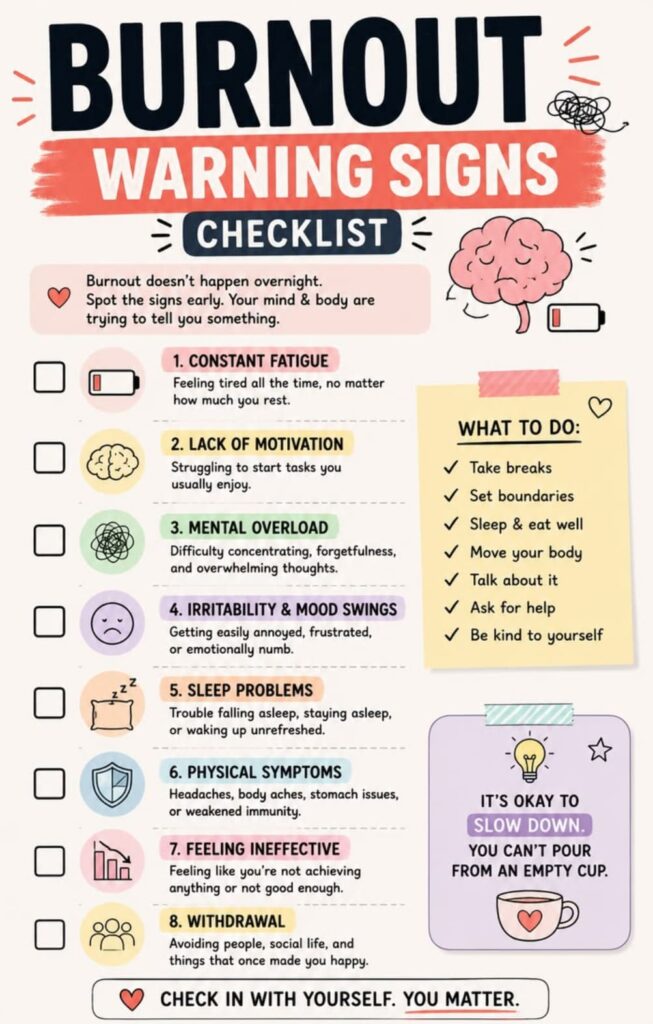
Burnout can develop gradually.
Watch for patterns such as:
- Feeling exhausted before the workday begins.
- Losing motivation for tasks you previously handled well.
- Becoming unusually irritable.
- Difficulty concentrating.
- Feeling emotionally detached from work.
- Working longer but accomplishing less.
- Constantly thinking about work after hours.
- Avoiding colleagues or communication.
- Sleep problems.
- Feeling that you can never truly switch off.
One difficult week does not automatically mean burnout.
The concern is a persistent pattern that affects your wellbeing and functioning.
If symptoms are persistent, severe, or interfering with daily life, consider speaking with a qualified healthcare or mental health professional.
Remote Work Burnout: Prevention Is Not Just Self-Care
It is important not to place the entire responsibility for burnout prevention on employees.
A worker can practice excellent self-care and still experience harmful workplace conditions.
The WHO recommends organizational interventions that address working conditions and environments, while the ILO emphasizes prevention of psychosocial risks through organizational and individual measures.
Employers can help by:
- Setting realistic workloads.
- Clarifying responsibilities.
- Providing appropriate equipment.
- Training managers.
- Supporting flexible work arrangements.
- Establishing reasonable communication expectations.
- Encouraging adequate rest.
- Providing mental-health resources.
- Preventing harassment and discrimination.
- Respecting employees’ non-working time.
Healthy remote work requires cooperation between employees and organizations.
What Managers Can Do to Prevent Burnout in Remote Teams
Managers have a particularly important role because remote employees may have fewer opportunities to communicate concerns informally.
Effective managers can:
Clarify Priorities
Employees should understand what matters most.
Avoid Constant Monitoring
Productivity should not depend on employees proving that they are online every minute.
Respect Working Hours
Do not create an expectation that workers must respond outside agreed hours.
Encourage Breaks and Leave
Rest should not be treated as a lack of commitment.
Maintain Regular Human Connection
Remote management should include meaningful communication, not only task updates.
Ask About Workload
Instead of asking only, “Is everything done?”
Ask:
“Is your current workload manageable?”
That question can reveal problems earlier.
Remote Work Burnout vs. Ordinary Work Stress
Stress and burnout are related but not identical.
Work stress may occur during a demanding project and improve after the pressure decreases.
Burnout tends to involve prolonged, unmanaged workplace stress and can involve emotional exhaustion, detachment, and reduced effectiveness.
The ILO describes work-related stress as a response that can occur when demands exceed a person’s ability or resources to cope; prolonged or severe work-related stress can contribute to harm.
If you’re unsure whether what you’re experiencing is burnout, anxiety, depression, or another condition, a qualified professional can help assess what is happening.
A Simple Remote Work Burnout Prevention Checklist
Before finishing your workday, ask:
☐ Did I take meaningful breaks?
☐ Did I step away from my screen?
☐ Did I complete my most important priorities?
☐ Did I avoid unnecessary overtime?
☐ Did I communicate workload concerns?
☐ Did I disconnect from work after hours?
☐ Did I move my body today?
☐ Did I have meaningful social interaction?
☐ Did I protect time for recovery?
You do not need to achieve every item every day.
The purpose is to notice patterns before exhaustion becomes your normal.
Frequently Asked Questions
How can I prevent burnout while working remotely?
Set clear working hours, protect breaks, manage workload, create boundaries around notifications, maintain social connection, prioritize sleep and physical activity, and communicate early when demands become unrealistic.
Why does remote work cause burnout?
Remote work does not automatically cause burnout. However, blurred work-life boundaries, excessive workloads, constant digital communication, social isolation, unclear expectations, and insufficient recovery can increase psychosocial risks.
What are the signs of remote work burnout?
Common warning signs can include persistent exhaustion, reduced motivation, difficulty concentrating, irritability, emotional detachment, declining work effectiveness, and difficulty mentally switching off from work.
How do I stop working after hours when I work from home?
Create a defined finishing time, close work applications, turn off nonessential notifications, leave your workspace, and establish a consistent end-of-day ritual.
Can working from home affect mental health?
Yes. Remote work can support wellbeing for some people, but poorly organized telework can also contribute to isolation, burnout, excessive screen time, and blurred boundaries between work and personal life.
Should I tell my manager if I am experiencing burnout symptoms?
If your workload, working hours, expectations, or workplace conditions are contributing to ongoing distress, discussing the situation with an appropriate manager or workplace support resource may help identify practical changes.
When should I seek professional help?
Consider professional support when symptoms are persistent, worsening, or interfering significantly with sleep, relationships, daily activities, or your ability to function at work.
Final Thoughts
Remote work should give you greater flexibility—not turn your home into a workplace you can never leave.
Preventing burnout starts with recognizing that productivity and constant availability are not the same thing.
Build clear boundaries.
Take real breaks.
Protect your sleep.
Move regularly.
Stay connected.
Communicate when your workload becomes unrealistic.
And give yourself permission to stop working when the workday is over.
Most importantly, remember that burnout prevention is not solely an individual responsibility. Healthy remote work also depends on how organizations design jobs, manage workloads, communicate expectations, support workers, and respect boundaries.
Your career matters. But your wellbeing matters too.
Medical Disclaimer
This article is intended for general educational and informational purposes. It is not a substitute for professional medical, psychological, or mental-health advice, diagnosis, or treatment. If you are experiencing persistent or severe symptoms, speak with a qualified healthcare or mental-health professional.