






By mindnesto Editorial Team · Updated November 2026 · 12 min read
Research and references: Cross-cultural communication research, peer-reviewed studies, and academic resources cited in this article.
A simple hand movement can communicate more than words. It can express agreement, appreciation, greeting, frustration, or even disrespect. However, the meaning of a gesture is not always universal.
Imagine travelling abroad and giving someone a familiar thumbs-up to show approval. You intend to be friendly. Yet, in another cultural setting, the same movement might be interpreted differently.
This is why understanding cultural hand gestures matters. People communicate through movements as well as spoken language. However, communities develop different conventions for interpreting those movements.
Whether you travel internationally, work with global clients, study communication, or interact with people from different backgrounds, cultural awareness can help you avoid unnecessary misunderstandings.
In this guide, we explore how hand gestures differ across cultures, examine familiar examples, and explain how to communicate respectfully in international situations.
What Are Cultural Differences in Hand Gestures?
Cultural differences in hand gestures refer to variations in how communities use and interpret hand movements during communication.
A gesture can have a recognised meaning within one cultural group. However, another group may understand it differently or attach no particular meaning to it.
For example, a thumbs-up can communicate approval in many English-speaking settings. Nevertheless, its meaning and social acceptability are not identical everywhere.
These differences develop through social customs, language, traditions, shared experiences, and everyday interaction.
Researchers study these patterns as part of nonverbal communication.
The important point is simple: A hand gesture does not have one guaranteed meaning in every country or situation.
Why Do Hand Gestures Mean Different Things Across Cultures?
Hand gestures are learned and interpreted within social environments. People gradually become familiar with the movements used by their families, communities, and wider societies.
Several factors influence these interpretations.
1. Cultural conventions
Communities develop shared associations between particular movements and meanings.
For instance, a circle formed with the thumb and index finger may communicate approval in one setting. Elsewhere, it may represent money, another concept, or an offensive expression.
These conventional gestures are sometimes called emblems. They can communicate a message without requiring spoken words.
2. Language and communication habits
Languages differ in how they describe actions, directions, emotions, and relationships.
These differences can influence how people use gestures while speaking.
Researcher Sotaro Kita reviewed cross-cultural gesture research and identified several influences, including cultural conventions, spatial thinking, linguistic differences, and the social rules governing gesture use.
3. Social etiquette and respect
A movement that feels natural to one person may seem inappropriate to another.
For example, pointing directly at someone can feel normal in some situations. In other settings, it may be considered impolite.
Social expectations also influence when gestures are appropriate, how strongly they are performed, and who can use them.
4. Regional and generational differences
Culture is not a fixed set of rules.
A gesture may have different interpretations across regions within the same country. Its meaning can also change between generations.
Migration, entertainment, tourism, and social media introduce people to gestures from other communities. As a result, familiar meanings can spread and evolve.
5. The situation and relationship
The same gesture can communicate different things depending on the circumstances.
A movement between close friends may feel completely different during a formal business meeting.
Tone of voice, facial expression, physical distance, and spoken words also influence interpretation.
Therefore, avoid judging someone’s intentions from a single hand movement.
7 Common Hand Gestures With Different Cultural Meanings
The following examples demonstrate why cultural awareness matters. These are broad illustrations, not universal rules for entire countries.
Meanings can vary by region, community, gesture orientation, and situation.
1. The thumbs-up gesture
The thumbs-up is one of the most recognisable hand gestures internationally.
In many English-speaking settings, it communicates:
- Approval
- Agreement
- Encouragement
- A job well done
- A positive response
It is also familiar through digital communication, where people use the thumbs-up emoji to acknowledge messages.
However, the gesture has been reported to carry insulting associations in some cultural settings, including certain Greek contexts.
Its meaning can also depend on how it is performed and the relationship between people.
Communication lesson: Do not assume that a familiar sign has the same social meaning everywhere.
2. The OK hand sign
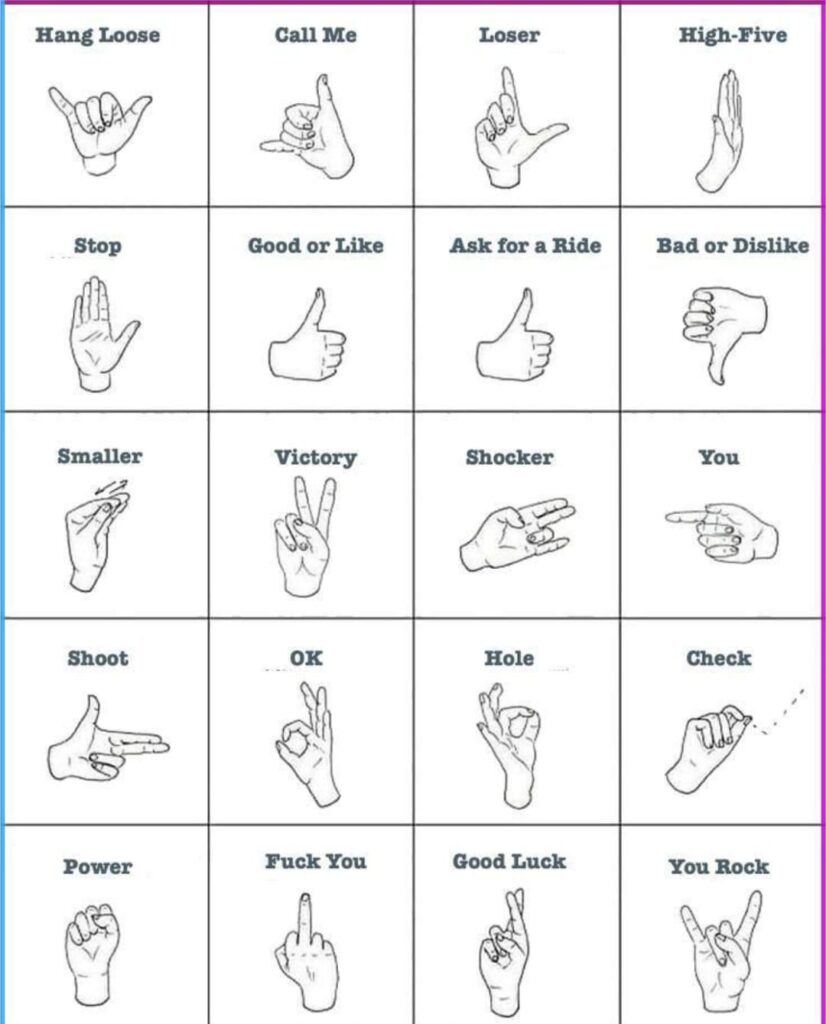
This gesture involves touching the thumb and index finger to form a circle while extending the remaining fingers.
In some settings, it means:
- Everything is fine
- Agreement
- Approval
- Something is satisfactory
However, this gesture has different associations in other communities.
For example, it can represent money in some Japanese contexts. It has also been reported as an obscene gesture in Brazil.
The meaning is not identical across all regions or situations.
Communication lesson: When travelling or working internationally, use spoken confirmation instead of relying entirely on this sign.
3. The V sign
The V sign involves extending the index and middle fingers to form a V shape.
Its meaning can change depending on palm orientation and cultural context.
With the palm facing outward, it is widely recognised as a sign of victory or peace in many settings.
However, in Britain and some other English-speaking contexts, turning the palm inward can make the gesture insulting.
This example shows why the direction of a hand movement matters.
Communication lesson: Even a small change in hand position can alter how a gesture is understood.
4. Pointing with the index finger
Pointing is useful when identifying objects, giving directions, or drawing attention to something.
However, pointing directly at another person can be considered impolite in some cultures and social situations.
People may prefer alternatives such as:
- Using an open hand
- Indicating an object with a broader movement
- Mentioning the person’s name
- Giving verbal directions
The acceptability of pointing also depends on the setting. Pointing at a presentation screen is not necessarily the same as pointing at someone’s face.
Communication lesson: When uncertain, use an open-hand gesture or clear verbal directions.
5. The beckoning gesture
Beckoning is used to invite someone to approach.
In some English-speaking settings, people raise a hand and curl one finger towards themselves.
However, this movement is not interpreted identically across cultures. Different communities use different hand positions and expectations when calling someone closer.
In some places, the upward-facing finger movement may seem rude or inappropriate.
A safer approach is to observe how people around you invite others and follow the local convention.
Communication lesson: Learn the locally accepted way to invite someone closer instead of assuming your familiar movement is appropriate.
6. The raised open palm
An open palm can communicate several things, including:
- Greeting
- Stopping
- Requesting attention
- Reassurance
- Emphasis during conversation
However, its interpretation depends on the direction, movement, and situation.
For example, raising an open hand to greet a colleague is different from pushing a palm towards someone during an argument.
Some open-palm movements also have specific cultural associations.
Communication lesson: Consider the complete interaction rather than interpreting the hand shape alone.
7. Counting with fingers
Finger counting is another example of cultural variation.
People may use different fingers or starting positions when counting.
For instance, some Americans and British people commonly begin counting with the index finger. Other Europeans may begin with the thumb.
This difference may seem minor. However, it can create confusion during transactions, classroom activities, or international conversations.
Communication lesson: When numbers matter, combine finger counting with spoken numbers or written information.
How Cultural Hand Gestures Affect International Communication
Cultural differences become especially important when people interact across national and linguistic boundaries.
A gesture can unintentionally change the meaning of a conversation.
International travel
Travellers often use familiar gestures when they cannot speak the local language.
A wave, pointing movement, or thumbs-up may seem like an easy way to communicate.
However, unfamiliar gestures can cause confusion.
Before travelling, learn a few local etiquette practices. Pay attention to how people greet others, request assistance, and express agreement.
Business meetings
International business communication requires awareness of different social expectations.
A gesture that appears confident in one professional environment may seem overly expressive in another.
For example, extensive hand movements may be welcomed during an informal presentation but feel distracting during a formal discussion.
Observe the communication style of your colleagues and clients.
Education and international classrooms
Teachers and students often use gestures to support explanations.
However, learners from different backgrounds may interpret the same movement differently.
Educators can reduce confusion by pairing gestures with clear verbal explanations.
Online meetings and video calls
Video communication creates additional challenges.
A hand movement may be partially outside the camera frame. Lighting and screen quality can also make it difficult to understand a gesture.
Therefore, international teams should avoid depending on hand signals alone.
Use clear language, written instructions, and confirmation questions when necessary.
How to Avoid Misunderstandings When Using Hand Gestures Abroad
You do not need to memorise every gesture used around the world. Instead, develop a respectful approach to cross-cultural communication.
1. Research local customs before travelling
Learn about common greetings, public etiquette, and gestures that may be inappropriate.
Reliable travel and cultural resources can help you prepare.
However, remember that cultural guides cannot represent every individual or community.
2. Observe before using unfamiliar gestures
Pay attention to how local people communicate.
Notice which movements they use during greetings, conversations, and professional interactions.
Observation can help you understand the social environment without making assumptions.
3. Use simple verbal communication
When a gesture may create confusion, use words.
For example, instead of relying on a thumbs-up, say:
- Yes, that is correct.
- I agree.
- Thank you.
- Everything is fine.
Clear language reduces dependence on uncertain signals.
4. Avoid exaggerated movements
Large or dramatic hand movements may attract unwanted attention in unfamiliar settings.
Use natural gestures and adjust your communication style to the situation.
This does not mean suppressing your personality. It means being aware of your surroundings.
5. Ask politely when something is unclear
If you are unsure about a gesture, ask what it means.
A respectful question can prevent misunderstandings.
For example:
“Could you explain what that gesture means in your culture?”
This shows interest rather than judgment.
6. Consider the complete communication context
Never interpret a hand movement in isolation.
Look at the conversation, facial expression, spoken words, relationship, and social setting.
A single gesture rarely provides enough information to establish someone’s intention.
Are Hand Gestures Universal?
No. Some hand movements are widely recognised, but their meanings and social rules are not completely universal.
Research on cross-cultural communication shows that gestures can vary in form, meaning, frequency, and social use.
A review by researcher Sotaro Kita identified several factors that influence cross-cultural gesture variation. These include cultural conventions, spatial cognition, language, and gestural practices.
A 2024 study comparing Italian and Swedish participants also examined differences in gesture use. It highlights why assumptions about national communication styles should be treated carefully.
Importantly, shared gestures do not mean that everyone interprets them identically.
Even within one country, people may have different experiences and preferences.
Do People Use More Hand Gestures in Some Cultures?
Gesture frequency can vary between individuals and groups.
However, it is misleading to assume that every person from a particular country communicates in the same way.
A 2024 study by Graziano and Gullberg examined gesture use among Italian and Swedish participants. The researchers reported differences in the frequency and types of gestures used in their study.
This does not prove that all Italians gesture more than all Swedes.
Individual personality, conversation topic, language, social setting, and personal communication habits can influence gesture use.
The more accurate conclusion is that cultural patterns can exist, but they do not determine every individual’s behaviour.
Cultural Awareness and Nonverbal Communication
Understanding cultural gestures is one part of broader nonverbal communication.
People communicate through several channels at the same time.
These include:
- Hand movements
- Facial expressions
- Eye contact
- Posture
- Physical distance
- Tone of voice
- Timing and pauses
Each channel can influence how a message is understood.
For example, an open palm accompanied by a friendly expression may communicate reassurance. The same movement during a tense conversation may have a different effect.
This is why communication should be understood as a complete interaction rather than a collection of isolated signals.
For a broader explanation, read our guide to hand gestures and their meanings.
Practical Tips for Respectful Cross-Cultural Communication
Building cultural awareness does not require perfection.
Instead, focus on a few practical habits.
Stay curious. Learn about customs without assuming that every person follows them.
Avoid stereotypes. Nationality does not determine an individual’s personality or communication style.
Use words when necessary. Clear language can prevent confusion when a gesture is unfamiliar.
Respect personal boundaries. Avoid touching people or using overly familiar movements without understanding the situation.
Be willing to correct mistakes. If someone explains that a gesture was inappropriate, listen and adjust.
Pay attention to context. The same movement can communicate different things in different circumstances.
These habits can make communication more respectful in workplaces, educational environments, travel, and everyday relationships.
Frequently Asked Questions
1. Why do hand gestures have different meanings in different cultures?
Hand gestures develop through cultural conventions, social experiences, language, and shared communication habits. Different communities can attach different meanings to the same movement.
2. Is the thumbs-up gesture offensive in every country?
No. It is a positive sign in many settings. However, it has been reported to carry insulting associations in some cultural contexts. Its interpretation depends on the region and situation.
3. What does the OK hand gesture mean around the world?
Its meaning varies. It can indicate approval in some settings, money in some Japanese contexts, and an offensive meaning in Brazil. Context and local convention matter.
4. Why is pointing considered rude in some cultures?
Pointing directly at someone can be viewed as disrespectful in certain social environments. Other communities use it more casually. An open hand can be a useful alternative when uncertain.
5. Does the V sign mean peace everywhere?
No. Its meaning can depend on palm orientation and local conventions. In some English-speaking contexts, the inward-facing version can be insulting.
6. Do hand gestures reveal someone’s personality?
No single hand gesture can reliably reveal someone’s personality, honesty, confidence, or intentions. Gesture interpretation requires context and should not be treated as a psychological diagnosis.
7. How can I learn cultural hand gestures before travelling?
Research the customs of your destination, consult reliable cultural resources, and observe local communication practices. Avoid relying on a single online gesture chart as a complete guide.
8. Are hand gestures important in international business?
Yes. They can support presentations, meetings, and everyday professional interactions. Cultural awareness helps reduce misunderstandings and encourages respectful communication.
9. Can hand gestures replace spoken language?
Sometimes a familiar gesture can communicate a simple message. However, gestures are not a reliable replacement for language in every situation, especially across cultures.
10. What is the safest way to communicate when I do not know a culture’s gestures?
Use clear, polite language, observe local customs, and ask respectful questions when necessary. Avoid unfamiliar or potentially offensive gestures until you understand their meaning.
Hand gestures are an important part of human communication. They can make conversations more expressive, support spoken language, and help people share ideas.
A word from mindnesto-
However, their meanings are shaped by culture and context.
A gesture that feels familiar to you may communicate something different to someone else. This does not mean that communication across cultures is difficult. It means that awareness and respect are essential.
The best approach is to remain observant, avoid assumptions, and use clear language when uncertainty arises.
Good communication is not simply about knowing what a gesture means. It is about understanding how another person may receive it.
References and Further Reading
- Kita, S. (2009). Cross-cultural variation of speech-accompanying gesture: A review. Language and Cognitive Processes, 24(2), 145–167. Read the research.
- Graziano, M. and Gullberg, M. (2024). Providing evidence for a well-worn stereotype: Italians and Swedes do gesture differently. Frontiers in Communication. Read the study.
- Virginia Commonwealth University. Language and Culture in Context: A Primer on Intercultural Communication — Gestures Across Cultures. Read the educational resource.
- University of Minnesota Open Educational Resources. Nonverbal Communication and Culture. Read the chapter.
Editorial note: Cultural examples are general educational illustrations. They do not represent every individual within a country or community. Gesture meanings can change by region, context, and generation.
Disclaimer: This article is intended for educational purposes. It does not provide psychological diagnosis or professional advice.