






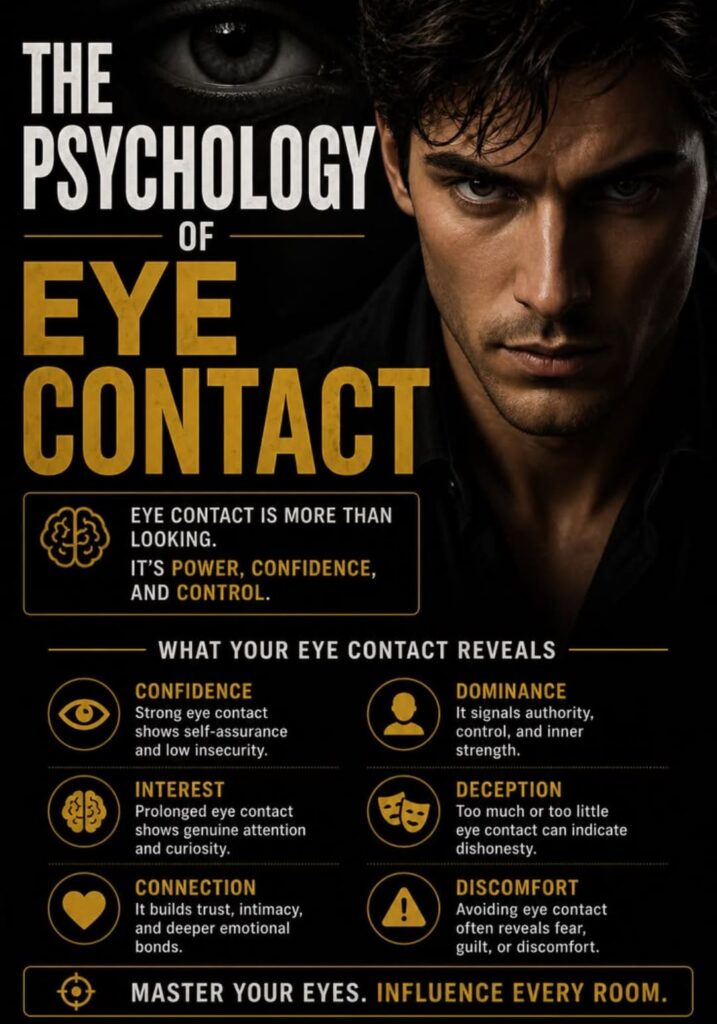
Have you ever caught someone staring at you and immediately wondered what it meant?
Was it attraction?
Confidence?
Curiosity?
Discomfort?
Or were you simply reading too much into a few seconds of eye contact?
Eye contact is one of the most noticeable forms of nonverbal communication. Yet it is also one of the easiest to misinterpret.
A long look does not automatically mean attraction. Looking away does not prove dishonesty. And avoiding eye contact does not necessarily mean someone lacks confidence.
Research shows that gaze plays an important role in face-to-face interaction,
attention, social connection, and emotional processing. However, its meaning depends on context, relationship, culture, individual differences, and what happens alongside the gaze.
So, what does eye contact mean?
The most accurate answer is:
Eye contact can communicate attention, connection, engagement, discomfort, social interest, or intensity—but one glance rarely tells you the whole story.
This guide explains nine common eye-contact signals people often misread and how to interpret them more carefully.
What Does Eye Contact Mean?
Eye contact happens when two people look directly into each other’s eyes during an interaction.
It is part of broader nonverbal communication and can influence attention, emotional responses, interpersonal connection, and conversational flow. Research on gaze suggests that where people look, when they look, and how long they look all contribute to face-to-face interaction.
However, eye contact does not have a universal dictionary.
The same behavior can mean something completely different depending on the situation.
For example, prolonged eye contact between romantic partners may feel intimate.
The same gaze from a stranger may feel uncomfortable.
Averted gaze during a difficult conversation might indicate discomfort.
It could also simply mean the person is thinking.
That is why context matters.
9 Eye-Contact Signals People Often Misread
1. Comfortable Eye Contact May Signal Engagement
When someone maintains comfortable eye contact while listening, responding, and participating in a conversation, it may indicate that they are engaged.
They may be paying attention.
They may feel comfortable with the interaction.
They may be showing social responsiveness.
However, it does not prove that they agree with everything you say.
Likewise, someone who looks away occasionally is not necessarily uninterested.
Natural conversations involve shifts in gaze.
What to look for
nstead of counting seconds, consider the overall interaction.
Ask:
- Are they listening?
- Are they responding naturally?
- Does their facial expression fit the conversation?
- Do they appear relaxed?
- Is their gaze changing naturally?
The pattern is more useful than the number of seconds.
2. Prolonged Eye Contact Can Increase Intensity
When someone holds your gaze noticeably longer than expected, the interaction may suddenly feel more intense.
That intensity can be positive, neutral, or uncomfortable.
Research has linked direct gaze with changes in attention and affective processing. In interpersonal situations, prolonged eye contact can also contribute to feelings of closeness or emotional intensity.
But prolonged eye contact does not automatically equal attraction.
It could reflect:
- Romantic interest
- Curiosity
- Concentration
- Confidence
- Social dominance
- Emotional intensity
- An attempt to maintain attention
- Simple conversational habit
Therefore, ask what else is happening.
A warm smile and relaxed conversation create a different context from a fixed stare accompanied by tension.
3. Avoiding Eye Contact Does Not Mean Someone Is Lying
This is one of the biggest myths in body-language content.
Someone looks away.
You assume:
“They must be hiding something.”
Not necessarily.
People may reduce eye contact because they are:
- Thinking
- Nervous
- Distracted
- Emotionally uncomfortable
- Tired
- Processing information
- Following their cultural norms
- Using a personal communication style
Eye gaze alone is not a reliable lie detector.
Your existing Mindnesto body-language guide correctly emphasizes that gaze avoidance should not be treated as proof of dishonesty.
So, if honesty matters, use conversation and evidence—not eye contact as a verdict.
4. Looking Away May Mean Someone Is Thinking
Have you ever asked someone a difficult question and noticed them look away?
It is tempting to interpret that as avoidance.
However, looking away can happen when people are concentrating or processing information.
Gaze behavior is closely involved with cognitive and social processes. People naturally shift where they look during conversations rather than maintaining uninterrupted eye contact.
For example, someone might look away while trying to remember:
- A person’s name
- What happened earlier
- A specific detail
- How they feel
- How they want to answer
Therefore, looking away should not automatically be interpreted as rejection or dishonesty.
Sometimes the person is simply thinking.
5. Repeated Eye Contact Can Signal Social Interest
Suppose someone repeatedly looks toward you during a conversation.
You notice they look away.
Then they look back.
Does it mean they like you?
Maybe—but you cannot know from that behavior alone.
Repeated eye contact can indicate that someone is paying attention to you or is interested in continuing an interaction.
In romantic contexts, gaze can also contribute to feelings of attraction and connection. However, research does not support treating eye contact as a guaranteed indicator of romantic interest.
Look for additional evidence.
For example:
- Do they initiate conversation?
- Do they seem comfortable around you?
- Do they actively engage?
- Do they respect your boundaries?
- Do their words and behavior align?
Eye contact is a clue—not a confession.
6. Breaking Eye Contact Can Regulate Social Intensity
Constant eye contact can feel intense.
That is why people naturally look away during conversations.
Briefly breaking eye contact can help regulate the interaction and reduce social intensity.
In other words, looking away is not necessarily a negative signal.
Sometimes it is simply part of normal conversation.
Think about it this way:
Eye contact connects people, while changes in gaze help regulate the interaction.
That is one reason natural conversation rarely looks like two people staring continuously at each other.
7. Strong Eye Contact Can Feel Like Confidence—but Context Matters
People often associate direct eye contact with confidence.
There can be some truth behind that perception.
A person who maintains comfortable eye contact while speaking may appear more engaged or socially confident.
However, the relationship is not that simple.
Someone can be confident without maintaining prolonged eye contact.
Another person may want to make eye contact but find it uncomfortable because of anxiety, culture, personal preference, or neurodivergence.
Therefore:
Do not judge confidence from eye contact alone.
Look at the entire communication pattern.
8. Eye Contact Can Feel Different Across Cultures
This is particularly important when interpreting people from different cultural backgrounds.
Eye-contact expectations are not universal.
The CDC’s 2026 Yellow Book notes that the degree and duration of acceptable eye contact can vary between cultures. In some settings, avoiding direct eye contact can communicate respect, while other settings may place greater value on direct gaze.
This means a behavior that looks like:
“disinterest”
to one person may actually communicate:
“respect”
to another.
Therefore, cultural context should always be considered before interpreting eye contact.
Never turn a cultural difference into a personality judgment.
9. Changes in Eye Contact May Be More Informative Than Eye Contact Itself
One of the most useful principles in reading nonverbal behavior is to notice changes from a person’s normal pattern.
Imagine someone usually maintains comfortable eye contact with you.
During a particular conversation, they suddenly begin looking away repeatedly.
That change may be worth noticing.
ut even then, you do not know the reason.
Perhaps the topic is uncomfortable.
Perhaps they are tired.
Perhaps they are distracted.
Perhaps something happened before the conversation.
The change gives you a reason to become curious—not permission to make a conclusion.
Does Eye Contact Mean Attraction?
Sometimes eye contact can occur alongside attraction.
However, eye contact alone cannot establish romantic interest.
Research on prolonged eye contact suggests that gaze can contribute to feelings of closeness and connection, but it does not manufacture attraction where there is none.
So instead of asking:
“They looked at me for five seconds. Do they like me?”
Ask:
“What else is happening between us?”
Look for reciprocal communication, comfortable interaction, mutual interest, and consistent behavior.
Most importantly, respect what the person actually communicates.
Does Avoiding Eye Contact Mean Anxiety?
Not necessarily.
Anxiety can influence eye contact, but avoiding gaze can have many explanations.
A person might:
- Feel socially uncomfortable
- Be concentrating
- Feel overwhelmed
- Prefer less direct gaze
- Follow cultural expectations
- Have a different communication style
- Simply be distracted
Eye-contact patterns also vary across neurodivergent populations. A 2024 scoping review examining eye-contact appearance and interpretation across social and psychiatric populations found substantial variation, highlighting why simplistic interpretations can be misleading.
So, avoid turning eye contact into a diagnostic tool.
Can Eye Contact Reveal If Someone Is Lying?
No—not reliably.
Looking away is not proof of lying.
Maintaining eye contact is not proof of honesty either.
A person who is nervous may avoid your gaze.
A confident liar may maintain eye contact.
An honest person may look away because they are thinking.
That is why important judgments should be based on evidence, communication, consistency, and context, rather than one nonverbal behavior.
Your body-language interpretation should create questions, not accusations.
Why Eye Contact Can Feel So Powerful
There is a reason eye contact can feel emotionally intense.
Direct gaze has been shown to influence attention and social processing. Research reviews describe eye contact as an important component of human social interaction and highlight its effects on cognitive and affective processes.
When someone looks directly at you, you may immediately become more aware of the interaction.
You may wonder:
Why are they looking at me?
What are they thinking?
Do they understand me?
Are they interested?
That heightened awareness can make eye contact feel much more meaningful than an ordinary glance.
But feeling intense does not mean the meaning is obvious.
Eye Contact and Neurodiversity: Why One Standard Does Not Fit Everyone
Healthy communication does not require everyone to use eye contact in exactly the same way.
Some autistic people may experience direct eye contact differently.
Some people find sustained eye contact distracting or uncomfortable.
Others may naturally use less or more gaze during conversations.
Current research and clinical discussion increasingly emphasize understanding eye-looking within broader social interaction rather than treating eye contact as a simple behavior that everyone must perform identically.
That is important because forcing one communication style onto everyone can create unnecessary pressure.
Good communication is about connection—not performance.

How to Read Eye Contact More Accurately
If you want to become better at understanding nonverbal communication, use this five-step method.
1. Establish the Baseline
Ask:
What is normal for this person?
Someone who normally looks away while thinking should not suddenly be labeled nervous every time they do it.
2. Notice Changes
A sudden change can be more informative than a consistent habit.
3. Look at Clusters
Combine gaze with:
- Facial expression
- Tone of voice
- Posture
- Words
- Physical distance
- Conversation flow
One cue is rarely enough.
4. Consider Context
Ask what is happening around the interaction.
The same gaze can mean different things in a job interview, romantic relationship, classroom, family conversation, or disagreement.
5. Communicate Instead of Guessing
If something important is unclear, ask.
For example:
“You seem a little uncomfortable. Do you want to talk about it?”
That is healthier than:
“You’re avoiding eye contact, so I know you’re hiding something.”
7 Eye-Contact Mistakes to Avoid
1. Assuming eye contact equals attraction
It may—but it may not.
2. Assuming looking away equals lying
There is no reliable rule like this.
3. Treating prolonged eye contact as universally positive
A prolonged stare can feel uncomfortable or threatening depending on context.
4. Ignoring cultural differences
Eye-contact norms vary.
5. Ignoring neurodiversity
Not everyone communicates through gaze in the same way.
6. Focusing on one cue
Body language works through multiple channels.
7. Forgetting direct communication
If the answer matters, ask the person.
The Bottom Line: What Does Eye Contact Really Mean?
Eye contact can mean many things.
It may communicate:
- Attention
- Engagement
- Connection
- Curiosity
- Social interest
- Emotional intensity
- Discomfort
- Confidence
- Or simply ordinary conversational attention
But there is no universal eye-contact code.
The most reliable approach is to consider context, baseline, culture, individual differences, clusters of behavior, and direct communication.
Your eyes can communicate.
They can attract attention.
They can create connection.
They can make an interaction feel intense.
But they cannot give you a perfect window into another person’s mind.
So the next time someone holds your gaze, pause before creating a story around it.
Notice it.
Consider the context.
Look for the wider pattern.
And when something truly matters, ask.
That is not only better psychology.
It is better communication.
Frequently Asked Questions
What does eye contact mean psychologically?
Eye contact is a form of nonverbal communication that can influence attention, social engagement, emotional processing, and interpersonal connection. Its meaning depends on context and individual differences.
What does prolonged eye contact mean?
Prolonged eye contact can increase the emotional intensity of an interaction. It may occur with attraction, connection, confidence, curiosity, concentration, or other social intentions. It does not have one universal meaning.
Does eye contact mean someone likes you?
It can be one possible sign of interest, but eye contact alone cannot prove romantic attraction. Look for reciprocal and consistent communication instead.
Is avoiding eye contact a sign of lying?
No. Avoiding eye contact is not a reliable indicator of deception. People look away for many cognitive, emotional, cultural, and personal reasons.
Why does eye contact feel so intense?
Direct gaze can influence attention and affective processing, which may make an interaction feel more socially or emotionally significant.
Is eye contact different across cultures?
Yes. Expectations around the amount and duration of eye contact vary across cultures. What feels respectful in one setting may feel uncomfortable or inappropriate in another.
Can eye contact show confidence?
Comfortable eye contact may contribute to how confident or engaged someone appears, but confidence cannot be accurately judged from eye contact alone.
How can I get better at reading eye contact?
Focus on patterns rather than isolated moments. Establish a person’s baseline, notice changes, consider context and culture, and use direct communication when an important interpretation needs confirmation.
Related Reading on Mindnesto
Continue learning with our pillar guide:
How to Read Body Language: 7 Signs to Notice
Medical & Psychological Disclaimer
This article is for educational purposes only and is not a psychological diagnosis or substitute for professional mental-health advice. Eye contact and other nonverbal behaviors have multiple possible explanations and should not be used alone to diagnose anxiety, autism, deception, attraction, or any other condition. If you are experiencing significant distress or concerns about your mental health or relationships, consider speaking with a qualified mental-health or healthcare professional.







Never non much Abt eyes 👀 great wrting