





By mindnesto Editorial Team · Updated November 2026 · 10 min read
Evidence-informed educational article — research references include Nature Reviews Psychology, Annual Review of Psychology, Psychological Bulletin, and peer-reviewed gesture and communication studies.
Hand gestures are part of everyday communication. We move our hands when explaining an idea, expressing excitement, emphasizing a point, or searching for the right words. Sometimes these movements happen so naturally that we barely notice them.
But what do hand gestures actually communicate?
Psychology and communication research suggest that hand movements can support spoken language, express information, and help people organize their thoughts. However, not every gesture has a universal psychological meaning.
A person rubbing their hands might be cold, nervous, or simply trying to warm up. Someone keeping their hands still might be concentrating rather than feeling uncomfortable.
Understanding hand gestures therefore requires more than memorizing a list of body-language signs. It requires attention to context, communication style, circumstances, and the person’s overall behavior.
In this guide, we explore common hand movements, their possible meanings, and what research actually tells us about interpreting them.
⚠️Medical and Psychological Disclaimer: This article is intended for general educational purposes. It does not provide psychological diagnosis, clinical assessment, or a reliable method for determining another person’s thoughts, emotions, personality, or intentions.
What Do Hand Gestures Mean?
Hand gestures are movements of the hands and fingers that accompany or replace spoken communication. They can illustrate ideas, emphasize words, express emotions, and support thinking. Their meanings depend on context, culture, individual habits, and the situation. A single hand movement cannot reliably reveal someone’s thoughts, feelings, confidence, or intentions.
What Are Hand Gestures in Psychology?
Hand gestures are movements that people use during communication. They can accompany speech, communicate a message independently, or help someone think through an idea.
Researchers often distinguish between several types of gestures.
1. Iconic gestures
Iconic gestures visually represent an object, action, or idea.
For example, someone explaining the size of a box might use both hands to demonstrate its width.
These gestures help listeners visualize information.
2. Deictic gestures
Deictic gestures point towards people, objects, places, or directions.
Pointing towards a door while giving directions is a simple example.
They help establish what someone is referring to.
3. Metaphoric gestures
Metaphoric gestures communicate abstract ideas through physical movements.
For example, someone discussing career progress might move one hand upward to represent growth.
4. Beat gestures
Beat gestures are small, rhythmic hand movements that emphasize spoken words.
A speaker might move their hand slightly whenever they make an important point.
These movements can help organize and emphasize communication.
5. Conventional gestures
Conventional gestures have socially recognized meanings within particular communities or cultures.
Examples include waving hello, giving a thumbs-up, or making a particular hand sign.
However, their meanings can vary across cultures. Never assume that a familiar gesture communicates the same message everywhere.
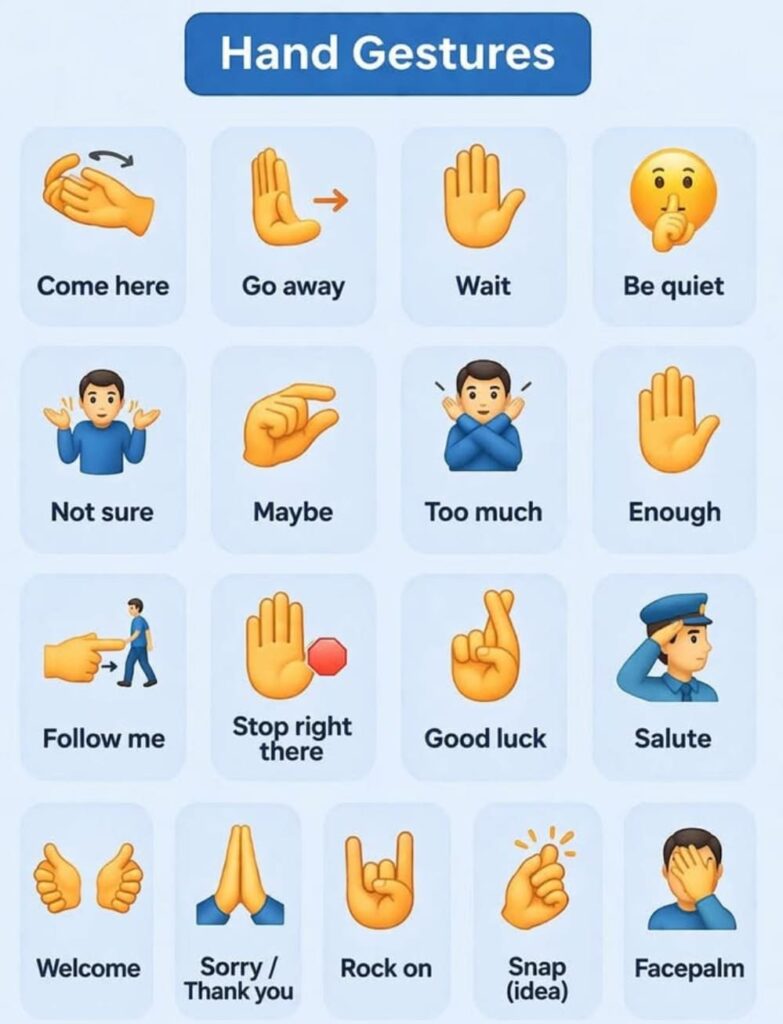
11 Common Hand Gestures and Their Possible Meanings
Hand movements can offer useful information about communication, but their interpretation should remain cautious.
Here are eleven common examples.
1. Open palms
Open palms are frequently used when explaining something, welcoming another person, or emphasizing openness.
They may contribute to an impression of approachability in certain situations.
However, open palms do not automatically prove honesty or trustworthiness. Their meaning depends on the broader interaction.
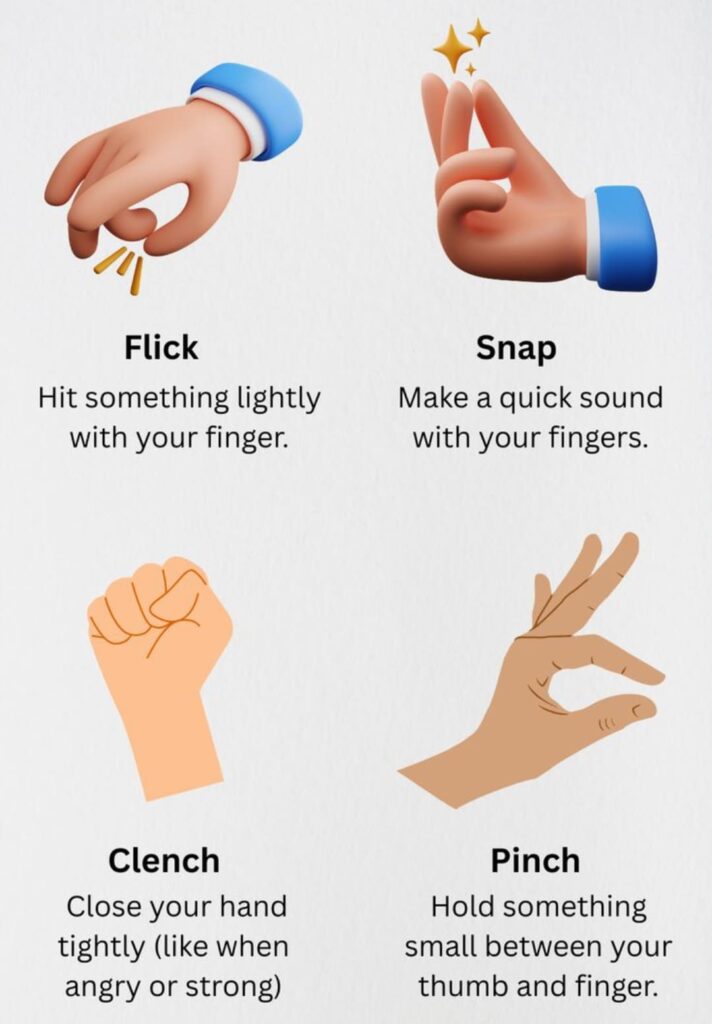
2. Clenched fists
A clenched fist can occur during physical effort, emotional tension, anger, concentration, or excitement.
For example, someone might clench a fist while celebrating a victory.
The movement alone cannot establish which emotion the person is experiencing.
3. Hands rubbing together
People rub their hands for several reasons.
They may be:
- Trying to warm their hands.
- Experiencing physical discomfort.
- Waiting for something.
- Engaging in a repetitive self-comforting movement.
- Expressing anticipation or excitement.
Look at the temperature, situation, facial expression, and accompanying behavior before interpreting the movement.
4. Finger steepling
Finger steepling occurs when someone brings their fingertips together, creating a shape resembling a small roof.
It is frequently discussed in popular body-language content as a sign of confidence or authority.
However, it should not be treated as proof of either quality.
A person might use this position while thinking, listening, explaining, or simply resting their hands.
5. Finger tapping
Finger tapping involves repeatedly moving one or more fingers against a surface or another object.
Possible explanations include:
- Restlessness.
- Impatience.
- Concentration.
- Habitual movement.
- Physical discomfort.
- Excitement.
It is not an automatic indication of anxiety.
6. Hands clasped together
Clasped hands may appear during conversations, meetings, presentations, and periods of concentration.
The position can be comfortable or habitual.
In some circumstances, people may clasp their hands when they feel uncertain or are trying to remain physically still.
Nevertheless, the gesture alone cannot reveal their emotional state.
7. Pointing fingers
Pointing helps direct another person’s attention towards an object or location.
It can also emphasize a particular statement.
Depending on the situation, pointing may appear helpful, assertive, instructional, or confrontational.
Cultural expectations and interpersonal relationships influence how this gesture is received.
8. Touching or rubbing fingertips
Some people repeatedly touch their fingertips when thinking, listening, waiting, or speaking.
This may be an ordinary self-regulatory habit rather than an emotional signal.
Consider whether the movement is habitual or whether it appears only during a particular situation.
9. Hands moving while speaking
Many people naturally gesture while talking.
They may use their hands to describe size, demonstrate movement, explain relationships, or emphasize important points.
Research suggests that these movements can help listeners understand spoken information.
10. Hiding hands
People sometimes place their hands inside their pockets, behind their backs, under a desk, or beneath their arms.
Possible reasons include comfort, temperature, personal habits, clothing, or the physical setting.
Hiding hands does not prove that someone is dishonest or hiding information.
11. Hands moving close to the face
Some people touch their chin, cheek, mouth, or forehead while thinking or speaking.
These movements may occur during concentration, physical discomfort, habitual self-touching, or emotional situations.
There is no reliable universal rule that touching the face indicates deception.
Why Do People Use Their Hands When Talking?
Hand gestures are not simply decorative movements. They can contribute to the way people formulate and communicate ideas.
A review by Susan Goldin-Meadow and Martha Wagner Alibali explains that gestures play important roles in speaking, learning, and thinking.
There are several reasons people naturally gesture while communicating.
Gestures help explain complicated ideas
Imagine explaining how to assemble a piece of furniture.
You might move your hands to demonstrate where one component fits into another.
The gesture provides a visual explanation that complements your words.
Gestures help emphasize important information
A speaker might use a small hand movement to highlight a key point.
This can help structure a presentation and direct listeners’ attention.
Gestures can support thinking
People sometimes move their hands while searching for an explanation or solving a problem.
Research suggests that gesture production and thinking are connected.
Gestures can improve communication
A 2011 meta-analysis examining 63 samples found that gestures provided a moderate benefit to listeners’ understanding.
More recent research published in the Journal of Marketing Research in 2026 also examined how certain explanatory hand movements can make spoken information easier to understand.
These findings suggest that gestures can contribute to effective communication, although their effects depend on the type of movement and the communication situation.
Can Hand Gestures Reveal Someone’s Emotions?
Hand gestures can contribute to emotional communication, but they cannot independently identify what another person feels.
For example:
- Repetitive movements might occur during restlessness or concentration.
- Clenched hands might accompany emotional tension or physical effort.
- Relaxed movements might appear during comfortable conversation.
- Large gestures might accompany enthusiasm or an expressive communication style.
However, these are possibilities rather than diagnostic signs.
The same movement can occur for different reasons.
A person may also experience an emotion without displaying an obvious physical gesture.
Therefore, it is better to understand hand movements as one part of communication rather than a reliable emotional detection system.
Why Context Matters When Interpreting Hand Gestures
Imagine two people rubbing their hands together.
One is standing outside in cold weather. The other is waiting for an important presentation to begin.
Although their movements look similar, their circumstances are different.
This illustrates why context matters.
Consider five factors before interpreting a hand gesture.
1. The environment
Temperature, physical comfort, available space, and surroundings can influence movement.
2. The conversation
A person explaining a complicated idea may gesture more frequently than someone listening quietly.
3. Individual habits
Some people naturally communicate with expressive hands, while others prefer minimal movement.
Neither style necessarily reveals a particular personality trait.
4. Cultural differences
Gestures can have different meanings across cultural and social settings.
An interpretation that seems familiar in one community may be misunderstood in another.
5. The overall interaction
Consider words, facial expressions, posture, timing, and the person’s response to the conversation.
Even then, avoid treating observations as proof of another person’s private thoughts.
How to Interpret Hand Gestures More Accurately
Rather than memorizing fixed meanings, use a more thoughtful approach.
Step 1: Observe without judging.
Describe the movement objectively. For example, say, “The person is repeatedly tapping their fingers.”
Avoid immediately deciding that they are nervous or impatient.
Step 2: Consider the situation.
Ask what is happening around the person.
Are they listening, presenting, waiting, working, or experiencing physical discomfort?
Step 3: Look for patterns.
Notice whether the movement is repeated or unusual for that individual.
One isolated movement provides limited information.
Step 4: Consider alternative explanations.
Could the person be cold, distracted, concentrating, or following a familiar habit?
Step 5: Communicate directly when necessary.
If a situation is important, ask a respectful question instead of relying on body-language assumptions.
Direct communication is generally more reliable than trying to guess someone’s intentions through gestures.
Frequently Asked Questions
What are the most common hand gestures?
Common hand gestures include open palms, pointing, finger tapping, clasped hands, clenched fists, finger steepling, and movements that accompany speech. Their meanings depend on context and individual communication styles.
Do hand gestures reveal personality?
Hand gestures can contribute to communication and may reflect habitual expressive styles. However, a single gesture cannot reliably establish someone’s personality, character, or intentions.
Why do people move their hands while speaking?
People use hand movements to illustrate ideas, emphasize important words, describe objects, and support communication. Research also connects gesture production with thinking and learning.
Does rubbing hands together mean someone is nervous?
Not necessarily. People rub their hands because they are cold, uncomfortable, anticipating an event, or following a habitual movement. Context is essential.
Is finger steepling a sign of confidence?
Finger steepling is often described as a confidence signal in popular body-language explanations. However, the position alone cannot establish confidence or authority.
Can hand gestures reveal that someone is lying?
No single hand gesture can reliably establish that someone is lying. Nervous movements, hidden hands, or changes in gesture frequency are not dependable proof of deception.
Are hand gestures universal across cultures?
Some gestures have widely recognized meanings, but many conventional gestures differ across cultures and communities. Their interpretation should account for cultural context.
Final Thoughts: Understand Gestures Without Making Assumptions
Hand gestures are an important part of human communication. They help people explain ideas, emphasize information, express themselves, and sometimes organize their thoughts.
However, interpreting them requires care.
A clenched fist does not always indicate anger. Rubbing hands does not always mean excitement. Finger steepling does not automatically prove confidence.
The most accurate approach is to consider the situation, communication style, cultural background, and broader interaction.
At mindnesto, we believe understanding human behavior should encourage curiosity, empathy, and better communication—not quick judgments about other people.
References and Further Reading
- Hostetter, A. B. (2011). When do gestures communicate? A meta-analysis. Psychological Bulletin. https://pubmed.ncbi.nlm.nih.gov/21355631/
- Goldin-Meadow, S., & Alibali, M. W. (2013). Gesture’s Role in Speaking, Learning, and Creating Language. Annual Review of Psychology. https://pmc.ncbi.nlm.nih.gov/articles/PMC3642279/
- Kita, S., & Emmorey, K. (2023). Gesture links language and cognition for spoken and signed languages. Nature Reviews Psychology. https://www.nature.com/articles/s44159-023-00186-9
- Cascio Rizzo, G. L., Berger, J., & Zhou, M. (2026). Talking with Your Hands: How Hand Gestures Influence Communication. Journal of Marketing Research. https://journals.sagepub.com/doi/10.1177/00222437251385922
- Goldin-Meadow, S. (2011). Learning through gesture. Wiley Interdisciplinary Reviews: Cognitive Science. https://pmc.ncbi.nlm.nih.gov/articles/PMC3813017/