







By mindnesto Editorial Team · Updated June 2026 · 10 min read
Reviewed for accuracy — sources cited from APA, Journal of Family Psychology, John Gottman Institute and peer-reviewed relationship neuroscience
Secure attachment communication is not simply about being honest or saying the right things. It is about creating — consistently and deliberately — the neurological conditions in which both people in a relationship feel genuinely safe enough to be fully known.
That distinction changes everything. Most relationship communication advice focuses on what to say. Secure attachment theory asks a deeper question: what does the other person need to feel safe enough to hear it?
Dr. John Bowlby — the British psychiatrist whose attachment theory transformed developmental psychology — identified the two fundamental requirements of a secure attachment relationship: a safe haven (a partner who provides comfort and regulation during stress) and a secure base (a partner who supports exploration and autonomy from a foundation of trust). Both requirements express themselves primarily through communication — through the quality of presence, attention, and responsiveness that partners consistently bring to their interactions.
This guide covers the neuroscience of secure attachment communication, what it looks like in daily relational life, and 10 specific strategies that build it — whether you are already securely attached, working toward it, or supporting a partner with a different attachment history.
We have linked this to our guides on healthy boundaries mental health and emotional intelligence mental health — because secure attachment communication and both emotional intelligence and healthy limits are inseparably connected.
Note: This article is for informational purposes. Significant relationship communication difficulties or attachment trauma may benefit from professional couples therapy or individual therapeutic support.
What Secure Attachment Actually Means in a Relationship
Attachment theory, developed by John Bowlby and subsequently expanded by Mary Ainsworth of the University of Virginia, identifies four primary attachment styles that develop in early childhood and shape relationship patterns across the entire lifespan.
Secure attachment — which Ainsworth found in approximately 55–65% of infants across cultures — develops when a caregiver responds consistently, sensitively, and warmly to a child’s emotional needs. Securely attached children learn that distress signals will be heard, that comfort is available, and that the relationship can survive conflict and repair. They carry that learning — encoded in what Bowlby called the internal working model — into every subsequent relationship.
In adult romantic relationships, secure attachment produces a characteristic communication style. Securely attached people express their needs directly without excessive anxiety. They hear their partner’s needs without becoming defensive. They tolerate conflict without catastrophising about the relationship’s survival. And they repair after disagreement with warmth rather than prolonged distance.
Importantly — and this is what Verywell Mind’s article misses entirely — secure attachment is not a fixed trait. Research on earned secure attachment demonstrates that adults who experienced insecure attachment in childhood can develop genuine security through consistent, healthy relationship experiences and therapeutic work. The internal working model is neurologically plastic. Secure attachment communication — consistently practised — is itself one of the most powerful mechanisms through which earned security develops.
The Four Attachment Styles and How They Communicate
Understanding the four styles prevents the misinterpretation of a partner’s communication behaviour as personal rejection or indifference.
Secure — communicates needs directly, listens without defensiveness, tolerates conflict, repairs effectively.
Anxious — hypervigilant to relational signals, tends to protest and pursue during conflict, needs frequent reassurance, may escalate to gain a response.
Avoidant — withdraws under emotional pressure, values independence over connection, tends to minimise emotional content, may appear dismissive during conflict.
Disorganised — simultaneous need for and fear of closeness, inconsistent and sometimes chaotic communication, often rooted in early trauma.
The Neuroscience of Secure Attachment Communication
Secure attachment is not just a relational style. It is a neurological state — and the communication patterns associated with it produce measurable biological differences in both partners.
Co-Regulation — The Biological Heart of Secure Communication
Dr. Dan Siegel of UCLA — whose interpersonal neurobiology framework has reshaped attachment-informed therapy — identifies co-regulation as the biological mechanism through which secure attachment communication heals and protects mental health.
Co-regulation occurs when one person’s regulated nervous system helps regulate another’s. During a difficult conversation, a partner who remains genuinely calm, present, and warm — who does not escalate, withdraw, or collapse — provides a physiological anchor that allows the other person’s nervous system to regulate alongside theirs. This is not merely emotional support. It is a measurable neurological event, mediated by the vagus nerve and producing reductions in cortisol and increases in oxytocin in both parties.
Secure attachment communication, at its most fundamental level, is the consistent provision of co-regulation — showing up as a calm, responsive, genuinely present nervous system even when the conversation is difficult.
Polyvagal Theory and Relationship Safety
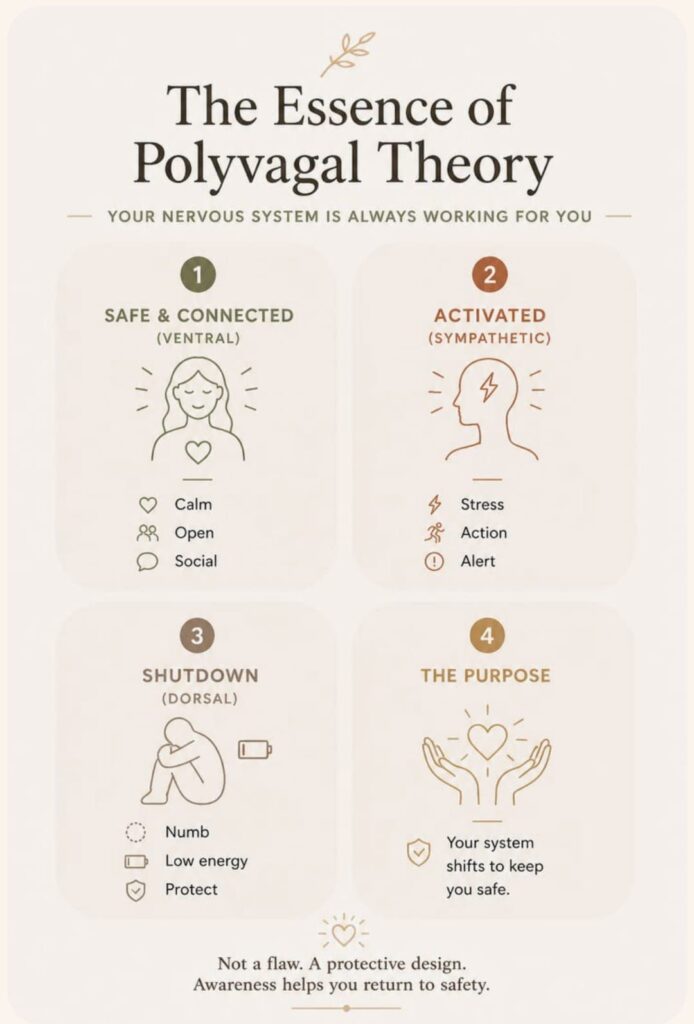
Dr. Stephen Porges of the University of Indiana — developer of Polyvagal Theory — identifies the ventral vagal pathway as the neurological foundation of genuine relational safety. When this pathway is active, people feel safe enough to engage socially, express vulnerability, and hear difficult things without becoming defensive or shutting down.
Polyvagal Theory explains why tone of voice, facial expression, and body language communicate safety or threat far more powerfully than words during difficult relationship conversations. Your nervous system reads your partner’s prosody — the music of their voice — before it processes the content of what they are saying. A warm tone in a difficult conversation activates ventral vagal safety. A cold or contemptuous one activates defensive survival circuits regardless of what the words actually convey.
Secure attachment communication is therefore not primarily about the content of what you say. It is about the physiological safety signals you transmit while saying it.
Positive Sentiment Override — The Buffer That Secure Partners Build
Dr. John Gottman of the University of Washington — whose research on relationship communication is the most longitudinal and comprehensive in relationship science — identified positive sentiment override as one of the clearest neurological markers of a securely functioning relationship.
In relationships with positive sentiment override, partners’ accumulated positive emotional memories of each other create a buffer that absorbs minor negativity, criticism, and conflict without triggering defensive escalation. A slightly sharp remark is interpreted as a bad moment — not as a fundamental character flaw. An awkward conversation is experienced as a temporary difficulty — not as evidence that the relationship is failing.
Couples without positive sentiment override — where negative sentiment override dominates — experience the inverse: neutral and even positive interactions are filtered through a negative relational lens. Building positive sentiment override is itself a communication strategy — one that requires consistent investment in positive, warm, attuned interactions during the ordinary, non-conflictual moments of shared life.
10 Strategies for Secure Attachment Communication
1. Respond to Emotional Bids — The Foundation of Everything
Dr. Gottman’s most important practical concept for daily relationship communication is the emotional bid — any attempt by one partner to make emotional contact with the other. Bids range from large (sharing deep vulnerability) to microscopic (pointing out an interesting bird, making a small joke, asking a casual question).
Research from the Gottman Institute found that couples who turned toward bids — acknowledged them, engaged with them, however briefly — showed dramatically better relationship outcomes than those who turned away or against them. Securely attached partners turn toward the overwhelming majority of their partner’s bids, even small and seemingly trivial ones.
The practical implication is significant. Secure attachment communication is not built primarily in difficult conversations. It is built in the accumulated pattern of small, warm, attentive responses to ordinary moments of contact across daily life.
2. Express Needs Directly — Without Disguising Them as Criticism
One of the clearest communication differences between secure and insecure attachment styles is the directness with which needs are expressed. Securely attached people say “I need more reassurance when I am anxious” rather than “You never support me when things are hard.”
This distinction — between a soft startup that names your need and a hard startup that begins with criticism or blame — is one of Gottman’s most replicated findings. Hard startups activate the partner’s amygdala defensively within the first three seconds of a difficult conversation, making genuine hearing and problem-solving neurologically much harder from that point forward.
Practise expressing needs using this structure: “When [specific situation], I feel [specific emotion], and what I need is [specific, actionable request].” This structure keeps the conversation in the partner’s prefrontal cortex — where collaborative problem-solving happens — rather than the amygdala, where defensive reaction lives.
3. Celebrate Your Partner’s Good News Actively and Specifically
Dr. Shelly Gable of the University of California Santa Barbara identified active constructive responding — responding to a partner’s good news with genuine, enthusiastic, specific engagement — as one of the strongest predictors of relationship satisfaction and longevity in her research.
Gable’s research, published in the Journal of Personality and Social Psychology, found that how partners respond to good news predicts relationship quality even more reliably than how they respond to bad news. Securely attached partners celebrate their partner’s successes with genuine curiosity and enthusiasm — asking specific questions, expressing real delight, and returning to the topic later.
Active constructive response example: “That is incredible — tell me exactly how it happened. How did you feel when they told you? What does this open up for you next?”
4. Regulate Yourself Before Attempting to Regulate a Difficult Conversation
Secure attachment communication becomes genuinely difficult when both partners are in a state of flooding — the physiological state identified by Gottman in which heart rate exceeds approximately 100 beats per minute and the nervous system has shifted from social engagement to survival mode.
Research from the Gottman Institute found that physiologically flooded partners literally cannot process social information or problem-solve effectively. Attempting to continue a difficult conversation while flooded produces escalation, not resolution.
Securely attached communication includes the capacity to call a time-out without abandonment — to say “I am too activated to hear you properly right now. I need 20 minutes to regulate, and then I genuinely want to continue this conversation,” then honour that commitment. The regulation, not the avoidance, is the secure act.
5. Repair — And Repair Early
Repair attempts — any gesture, word, or behaviour that interrupts negativity during or after a conflict — are, according to Gottman’s research, the single most important predictor of relationship success among couples who experience conflict. What differentiates stable from unstable relationships is not the absence of conflict. It is the effectiveness of repair.
Secure attachment communication includes a wide and well-practised repair repertoire. This might be a gentle touch during a tense conversation, a specific acknowledgment of the other person’s point, a small joke that both people genuinely find funny, or a direct statement — “I think I said that badly. Let me try again.” Any of these can interrupt the escalation cycle and return the conversation to safety.
Repair works most reliably when it is practised during low-conflict periods — so that it feels genuine rather than manipulative during high-conflict ones.
6. Listen to Understand — Not to Respond
The most common listening failure in relationship communication is listening to respond — processing what a partner says primarily for the purpose of formulating your counter-response rather than genuinely understanding their experience.
Secure attachment communication inverts this. It listens to understand — holding your own perspective in temporary suspension in order to genuinely enter your partner’s experience. This is not agreement. It is the neurological act of prioritising understanding before evaluation.
Three practices that build understanding-focused listening:
- Reflect back what you heard before responding: “What I hear you saying is ______. Is that right?”
- Ask one clarifying question before offering your perspective: “Help me understand what hurt most about that”
- Validate the emotion before addressing the content: “That makes complete sense that you would feel that way”
7. Communicate Acceptance of Your Partner’s Fundamental Nature
Securely attached partners consistently communicate something that goes beyond tolerating differences — they communicate genuine acceptance of who their partner fundamentally is. Research on unconditional positive regard in relationships — drawing on Carl Rogers’ humanistic framework — confirms that felt acceptance is one of the most powerful predictors of relationship security and individual mental health within a partnership.
This means communicating not just that you love your partner but that you genuinely like them — that their specific personality, their particular quirks, their characteristic way of being in the world is not something you are managing but something you actually value. That communication, delivered consistently and specifically, is one of the most powerful acts of secure attachment available.
8. Name Emotional States During Difficult Conversations
Affect labelling — naming your emotional state during a difficult conversation — is one of the most effective communication strategies supported by neuroscience. Research by Matthew Lieberman of UCLA confirms that naming an emotion reduces amygdala activation and increases prefrontal cortex engagement — making you more able to hear your partner and less likely to react defensively.
During a difficult relational conversation, naming your state keeps the interaction in the social engagement system rather than the defensive survival system. “I notice I am feeling defensive right now. I want to hear you — give me a moment to settle.” That sentence performs something neurologically significant: it acknowledges the activation without acting on it, and it communicates to your partner that you are choosing presence over reaction.
9. Build Rituals of Connection
Gottman’s research identifies rituals of connection — predictable, intentional shared moments that both partners actively protect — as one of the most important structural foundations of relationship security. These rituals are the physical scaffolding of positive sentiment override.
A ritual of connection can be as simple as a 6-second kiss goodbye each morning (which Gottman specifically researched), a genuinely present reunion conversation when both partners return home, a technology-free dinner together three times a week, or a weekly relationship check-in where both people share one appreciation and one current challenge. Their power lies not in their complexity but in their consistency — the repeated, reliable signal they send that the relationship is prioritised.
10. Work Toward Earned Secure Attachment
If your attachment history has left you with anxious, avoidant, or disorganised patterns, the most important thing to know is this: those patterns are not your permanent neurological destiny. Earned secure attachment — genuine relational security developed in adulthood through healthy relationship experiences and therapeutic work — is well-documented in the research literature.
The primary pathways to earned security are: consistent experience in a securely functioning relationship (with a partner, therapist, or close friend); attachment-focused psychotherapy that explicitly addresses the internal working model; and deliberate practice of the secure communication strategies in this guide.
Every time you choose a soft startup over a hard one, turn toward a bid rather than away from it, regulate before flooding, or repair after conflict — you are practising the neural patterns that earned secure attachment is built from. The brain’s plasticity means that consistent practice genuinely changes the underlying structure. For further support, please consider accessing our guides on toxic relationship recovery or professional therapy through the resources below.
Professional support:
- UK: NHS Talking Therapies | Relate UK
- USA: ADAA Therapist Finder
- Canada: CAMH
- Australia: Relationships Australia
Secure Attachment Communication Key Takeaways
The evidence-based summary:
- Secure attachment provides a safe haven (comfort during stress) and a secure base (support for exploration) — both expressed through communication
- Co-regulation is the neurological foundation of secure attachment communication — a calm, present nervous system regulates the partner’s
- Polyvagal Theory explains why tone, facial expression, and body language communicate safety or threat before words do
- Emotional bids — turning toward versus away — determine relationship quality more than any other single communication behaviour
- Soft startups — expressing needs rather than criticism — keep difficult conversations in the prefrontal cortex rather than the amygdala
- Active constructive responding to good news predicts relationship quality even more reliably than responses to bad news
- Flooding — physiological arousal above ~100bpm — makes genuine communication neurologically impossible; regulate before continuing
- Repair attempts — not conflict absence — are the primary predictor of relationship stability
- Earned secure attachment is real and achievable — consistent practice of secure communication strategies changes the brain’s relational patterns over time
A Word From mindnesto
At mindnesto, we believe that secure attachment communication is one of the most life-changing skills any person can develop — because the quality of your most intimate relationships shapes your mental health, your physical health, your professional performance, and your daily experience of being alive more than almost any other single factor.
The neuroscience is clear and the research is consistent. Secure attachment is not a personality type you were either born with or not. It is a set of neurologically-grounded communication practices that anyone, at any point in their relational life, can begin developing today.
One warm, specific, genuinely attentive response. One emotional bid turned toward rather than away. One repair offered and received. These are not small things. They are the building blocks of the relationship you actually want. 💙
→ Read next: Healthy Boundaries — Why They Matter and How to Set Them
→ Also read: Emotional Intelligence and Mental Health
Frequently Asked Questions
What is secure attachment communication?
Secure attachment communication is the consistent pattern of expressing needs directly, listening to understand rather than to respond, responding warmly to a partner’s emotional bids, repairing effectively after conflict, and providing co-regulation — the physiological safety of a calm, present nervous system — during difficult conversations. It is grounded in Bowlby and Ainsworth’s attachment theory and Gottman’s relationship research, both of which identify this communication pattern as the strongest predictor of relationship satisfaction and longevity.
Can you become securely attached as an adult?
Yes — through a process called earned secure attachment. Research confirms that adults who experienced insecure attachment in childhood can develop genuine security through consistent healthy relationship experiences and attachment-focused therapy. The brain’s neuroplasticity means that consistent practice of secure communication patterns — turning toward bids, expressing needs directly, repairing after conflict — creates lasting changes in the internal working model that underlies attachment style.
How does attachment style affect communication?
Attachment style shapes communication primarily through the internal working model — the unconscious template for relational safety and expectation formed in early childhood. Securely attached people communicate directly and tolerate conflict without catastrophising. Anxiously attached people often escalate to gain reassurance. Avoidantly attached people withdraw under emotional pressure. Disorganised attachment produces inconsistent, sometimes chaotic communication. All four styles are responsive to consistent experience in secure relational environments and to attachment-informed therapeutic support.
What are emotional bids in relationships?
Emotional bids are any attempt — large or small — to make emotional contact with a partner. Gottman’s research identifies turning toward bids (acknowledging and engaging with them) versus turning away (ignoring) as one of the strongest predictors of relationship quality and longevity. Bids range from sharing deep vulnerability to pointing out something interesting. Securely attached partners turn toward the vast majority of their partner’s bids, including the smallest and most easily overlooked ones.
What should I do when a conversation becomes too heated?
Take a time-out — not as abandonment but as regulation. Research from the Gottman Institute shows that physiological flooding (heart rate above approximately 100bpm) makes effective communication neurologically impossible. Tell your partner you need 20–30 minutes to regulate your nervous system and commit to returning to the conversation — then honour that commitment. This is itself a secure attachment act: prioritising quality of connection over the pressure to resolve immediately.
Sources and External References
- APA — Attachment Theory
- Gottman Institute — Relationship Research
- Journal of Family Psychology — Attachment Communication
- Journal of Personality and Social Psychology — Shelly Gable
- Psychological Science — Attachment Research
- NHS — Relationships and Mental Health
- Relate UK — Couples Counselling
- Mind UK — Relationships and Mental Health
- ADAA — Relationship Anxiety
- CAMH Canada
- Relationships Australia
- Beyond Blue Australia