





By mindnesto Editorial Team · Updated June 2026 · 10 min read
Reviewed for medical accuracy — sources cited from Harvard Health, Mayo Clinic, MedlinePlus, PubMed, and peer-reviewed research on emotional eating and stress.
Emotional eating is more than simply “eating too much.” Sometimes, food becomes a response to stress, boredom, loneliness, sadness, anxiety, frustration, or exhaustion. Recognizing what happens before the urge to eat can help you understand your patterns without judgment.
Stress Eating vs. Emotional Eating: What’s the Difference?
Have you ever eaten after a difficult day and wondered:
“Was I actually hungry, or was I eating because I was stressed?”
Sometimes the answer is not obvious.
Food and emotions can become connected through habits, routines, memories, and coping patterns.
Stress eating and emotional eating are often treated as the same thing.
They are related, but there is an important difference.
Stress eating has stress as the main trigger.
Emotional eating has a wider range of emotional triggers.
Understanding this distinction can help you notice your patterns without labeling yourself as “good” or “bad” for eating.
What Is Stress Eating?
Stress eating is eating that occurs in response to stress, pressure, or feeling overwhelmed.
Stress can come from many situations:
- demanding work
- academic pressure
- financial concerns
- relationship conflict
- family responsibilities
- deadlines
- lack of sleep
- major life changes
- ongoing uncertainty
For some people, stress reduces appetite.
For others, stress increases cravings or makes eating more frequent.
Stress responses vary considerably between individuals.
Research suggests that stress and mental workload can influence eating behavior and food choices, although the effects are not identical for everyone.
What Is Emotional Eating?
Emotional eating is a broader pattern.
It involves eating in response to emotions rather than physical hunger alone.
Possible triggers include:
- sadness
- boredom
- loneliness
- frustration
- anger
- anxiety
- disappointment
- stress
- celebration
- emotional exhaustion
For example, someone might eat ice cream because they feel lonely.
Another person might snack because they are bored.
Someone else might eat after an argument.
None of these situations automatically mean there is a serious problem.
Eating can be part of normal emotional experiences.
The concern is when food becomes a frequent or primary way of managing difficult emotions.
Stress Eating vs. Emotional Eating: The Simple Difference
Think of it this way:
| Stress Eating | Emotional Eating |
|---|---|
| Triggered mainly by stress | Triggered by many emotions |
| Often connected to pressure or overwhelm | Can involve sadness, boredom, loneliness, anger, anxiety, or stress |
| May occur during demanding periods | Can occur even without major stress |
| Stress is the main context | Emotion is the broader context |
| Can overlap with emotional eating | Includes stress eating in many situations |
The categories are not completely separate.
Stress eating can be a form of emotional eating.
But not every instance of emotional eating is caused by stress.
Why Does Food Feel Comforting During Stress?
Food can provide more than physical nourishment.
Eating can create a pause.
It can provide pleasure.
It can create a familiar routine.
It can offer temporary distraction.
For some people, certain foods become associated with comfort through repeated experiences.
During stressful moments, these learned associations can become stronger.
Harvard Health describes stress eating as a pattern that can include mindless snacking, grazing, and eating in response to stressful situations.
This does not mean that eating for comfort is automatically unhealthy.
It becomes more concerning when food is the only coping strategy available.
Why Do Emotions Trigger Eating?
Emotions can influence behavior in many ways.
When you feel uncomfortable, your brain naturally looks for ways to change or regulate that experience.
Food may provide a quick source of pleasure or distraction.
For example:
Boredom → looking for stimulation → snacking
Loneliness → looking for comfort → eating
Stress → looking for relief → reaching for familiar food
Fatigue → looking for energy or convenience → grabbing something quickly
These patterns can become automatic when repeated frequently.
The important question is not:
“Why am I so weak around food?”
A better question is:
“What need am I trying to meet right now?”
Physical Hunger vs. Emotional Hunger
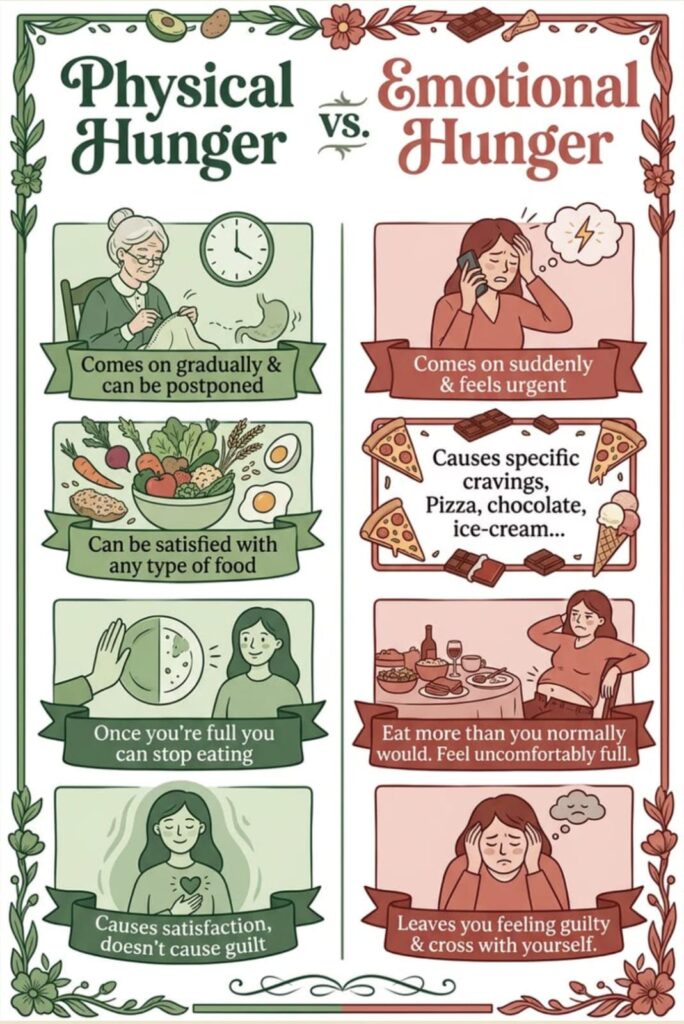
One useful skill is learning to notice the difference between physical hunger and an emotionally triggered urge.
Physical hunger may:
- develop gradually
- occur several hours after eating
- be satisfied by different foods
- reduce after eating
- come with physical sensations of hunger
Emotionally triggered eating may:
- appear suddenly
- follow a specific emotional event
- involve a strong desire for a particular food
- continue even after physical hunger decreases
- feel connected to comfort or distraction
But these signs are not absolute.
You do not need to perfectly classify every eating experience.
Hunger and emotions can happen at the same time.
Can You Be Both Stressed and Emotionally Hungry?
Yes.
Imagine you have worked for eight hours.
You skipped lunch.
You are exhausted.
Then you receive an upsetting message.
Now you want something comforting to eat.
What is happening?
You may be:
- physically hungry
- emotionally upset
- mentally exhausted
- stressed
- looking for comfort
Human behavior does not always fit into one category.
That is why rigid labels can sometimes create more stress.
Instead of asking:
“Is this stress eating or emotional eating?”
try asking:
“What is happening in my body, mind, and environment right now?”
7 Common Emotional Eating Triggers
1. Stress
Work pressure and daily responsibilities can make eating feel like an easy escape.
2. Boredom
When there is little stimulation, food can become something to do.
3. Loneliness
Eating may temporarily provide comfort or a sense of familiarity.
4. Frustration
After a difficult interaction, food may feel like a reward or emotional release.
5. Anxiety
Some people eat when they feel nervous or overwhelmed.
Others lose their appetite.
6. Fatigue
When you are exhausted, quick and convenient food choices may become more appealing.
7. Restriction and Food Rules
Overly rigid eating rules can make food mentally demanding and may contribute to cycles of restriction and overeating for some people.
If food rules are causing significant anxiety, professional guidance can be helpful.
6 Signs You May Be Stress Eating
You might notice that:
- You frequently eat after stressful situations.
- Cravings appear during periods of pressure.
- You snack while working or studying.
- You use food as your main way to take a break.
- Eating feels automatic during stressful moments.
- You notice the pattern more during busy or demanding periods.
One sign alone does not establish a problem.
Look for repeated patterns over time.
6 Signs Emotional Eating May Be Part of Your Pattern
You may notice:
- eating when you are bored
- eating when you feel lonely
- using food to soothe difficult emotions
- eating even when you are not physically hungry
- feeling that certain emotions automatically trigger food
- relying heavily on food to change your mood
Again, emotional eating exists on a spectrum.
Occasional emotional eating is part of normal human behavior.
The concern is persistent distress or loss of control.
Is Emotional Eating Always Bad?
No.
This is an important distinction.
Food has emotional and social meaning.
People eat during celebrations.
They share meals with family.
They enjoy favorite foods.
They may cook when they need comfort.
Not every emotionally influenced food choice needs to be corrected.
The goal is not to remove emotions from eating.
The goal is to develop flexibility.
Food can be enjoyable without becoming your only emotional coping tool.
How to Break the Stress-Eating Cycle
You do not need to fight the urge with punishment.
Try building awareness first.
Step 1: Identify the Trigger
Ask:
“What happened just before I wanted to eat?”
Was it:
- an email?
- an argument?
- boredom?
- exhaustion?
- loneliness?
- a difficult task?
Finding the trigger is more useful than blaming yourself.
Step 2: Check Your Hunger
Ask:
“When did I last eat?”
If you are hungry, eating is a reasonable response.
Do not turn hunger into something you need to defeat.
Step 3: Name the Emotion
Try one simple sentence:
“I feel overwhelmed.”
Or:
“I feel lonely.”
Or:
“I am exhausted.”
Putting an emotion into words can create a small pause between the feeling and the automatic response.
Step 4: Add Another Coping Option
If food is not what you need right now, try another response.
For example:
- step outside
- call someone
- listen to music
- stretch
- take several slow breaths
- write down what is bothering you
- take a short screen break
- rest
You are not banning food.
You are increasing your choices.
Step 5: Remove the Guilt
If you eat during stress, avoid the cycle:
Stress → eating → guilt → more stress → more eating
Instead, respond with curiosity.
Ask:
“What can I learn from this moment?”
That question is much more useful than:
“Why did I do that again?”
A Simple Stress-Eating Reset
When you notice an urge, try this:
PAUSE
Stop for a few seconds.
BREATHE
Take a slow breath.
CHECK
Notice your physical hunger.
NAME
Identify the emotion.
CHOOSE
Decide what would support you.
ACCEPT
Avoid judging yourself afterward.
This is awareness, not restriction.
How Mindful Eating Can Help
Mindful eating encourages greater awareness of the eating experience.
Instead of eating automatically, you can slow down enough to notice:
- taste
- texture
- hunger
- fullness
- satisfaction
- emotions
- distractions
It does not require perfect concentration.
Even one mindful meal or snack can help you observe your patterns.
The goal is not to control every bite.
It is to become more present.
When Stress Eating Needs More Attention
Occasional stress eating is not necessarily a mental-health problem.
Consider professional support if eating regularly feels out of control or causes significant distress.
Seek guidance if you experience:
- repeated episodes of loss of control
- intense shame around eating
- severe anxiety about food
- persistent restrictive behavior
- frequent cycles of restriction and overeating
- significant changes in appetite
- eating patterns that interfere with everyday life
A qualified healthcare professional can help determine what is happening and recommend appropriate support.
What Can You Do Today?
You do not need to completely change your relationship with food today.
The next time you want to eat outside your usual routine, pause and ask:
1. Am I physically hungry?
2. What am I feeling?
3. What happened before this urge?
4. What would help me right now?
Then make your choice without judgment.
Sometimes the answer will be food.
Sometimes it will be rest.
Sometimes it will be connection.
Sometimes it will be both.
FAQs
Is stress eating the same as emotional eating?
No. Stress eating specifically involves stress as a trigger. Emotional eating is broader and can involve sadness, boredom, loneliness, anxiety, frustration, or stress.
Can stress eating be a type of emotional eating?
Yes. Stress eating can be considered one form of emotionally influenced eating because stress can trigger emotional and behavioral responses.
Why do I eat when I am stressed but not hungry?
Food can provide comfort, distraction, pleasure, or a mental break. Stress can also influence habits and cravings.
How can I stop emotional eating?
Start by identifying your triggers. Check your physical hunger, name the emotion, and build additional coping strategies. Avoid shame and extreme restriction.
Is emotional eating a disorder?
Not necessarily. Emotional eating can occur occasionally. Persistent distress, loss of control, or significant interference with daily life may require professional assessment.
Does stress always increase appetite?
No. Stress affects people differently. Some people eat more, while others experience reduced appetite or disrupted eating patterns.
A word from mindnesto-
At mindnesto we believe stress eating and emotional eating overlap, but they are not exactly the same.
Stress eating centers on stress.
Emotional eating includes a much wider range of emotional triggers.
Neither label should become a reason for shame.
Instead, use them as clues.
Notice what happens before you eat.
Check your hunger.
Recognize your emotions.
Create more than one way to cope.
And remember:
Understanding your eating pattern is more powerful than judging it.
Medical Disclaimer
This article is for educational purposes only. It does not provide medical or psychological diagnosis or treatment. If eating patterns cause significant distress, loss of control, or interfere with daily life, consider speaking with a qualified healthcare professional.