






By mindnesto Editorial Team · Updated June 2026 · 9 min read
Sources cited from Cornell University, Psychological Science, Journal of Behavioral Decision Making 2024, PMC, ScienceDirect and peer-reviewed consumer psychology research
Think about the last purchase that genuinely excited you. The thing you spent time researching, looked forward to owning, and felt a real surge of pleasure when you finally had in your hands. Now think about how you feel about that same purchase today. If it was a material object — a piece of technology, a clothing item, a piece of furniture — there is a reasonable chance you barely notice it anymore. It blends into the background of your life, as unremarkable now as everything else you own.
This is not ingratitude. It is neuroscience. And it is the most important thing to understand about how spending money can — or cannot — make you happy.
Professor Thomas Gilovich of Cornell University — who has spent over two decades studying the relationship between spending and happiness — identified the fundamental problem with buying things as a happiness strategy in one sentence. One of the enemies of happiness is adaptation. We buy things to make us happy, and we succeed. But only for a while. New things are exciting to us at first, but then we adapt to them.
The alternative he and his colleagues have identified through two decades of rigorous research is consistently, robustly, and cross-culturally superior: buying experiences.
This guide covers the complete science — why experiences produce greater happiness than possessions at every stage of the purchase cycle, the specific mechanisms that explain it, and a practical framework for shifting your spending toward the categories of experience that produce the strongest wellbeing returns.
We have connected this to our can money buy happiness guide, our prosocial spending guide, and our does money make you happy guide — because the experiences-vs-things finding is one of the most important practical conclusions from the entire money-happiness research corpus.
Note: This article is for general informational and educational purposes.
Why Do Experiences Make You Happier Than Things? The Science
Experiences produce greater and more lasting happiness than material possessions because they resist hedonic adaptation — the brain’s tendency to habituate to new circumstances — through three mechanisms: they activate anticipatory happiness before they occur, they provide moment-to-moment joy during the experience itself, and they generate remembered happiness indefinitely afterward through narrative memory. Material possessions activate only the present moment of pleasure, which adaptation then rapidly neutralises.
Research consistently demonstrates that people derive more happiness from experiential purchases — such as travel, entertainment, dining, and outdoor activities — than from material purchases such as clothing and gadgets. Happiness was higher for all experiential categories studied than all material categories. Experiences elicit greater in-the-moment happiness relative to possessions.
The finding has been replicated consistently across cultures, income levels, and demographic groups — making it one of the most robust practical findings in happiness science.
The Three-Phase Happiness Advantage of Experiences
This is the framework that no competitor article provides — and it is the most complete explanation of why experiences outperform possessions across the entire purchase lifecycle.
Phase 1 — Anticipatory Happiness: Experiences Win Before They Begin
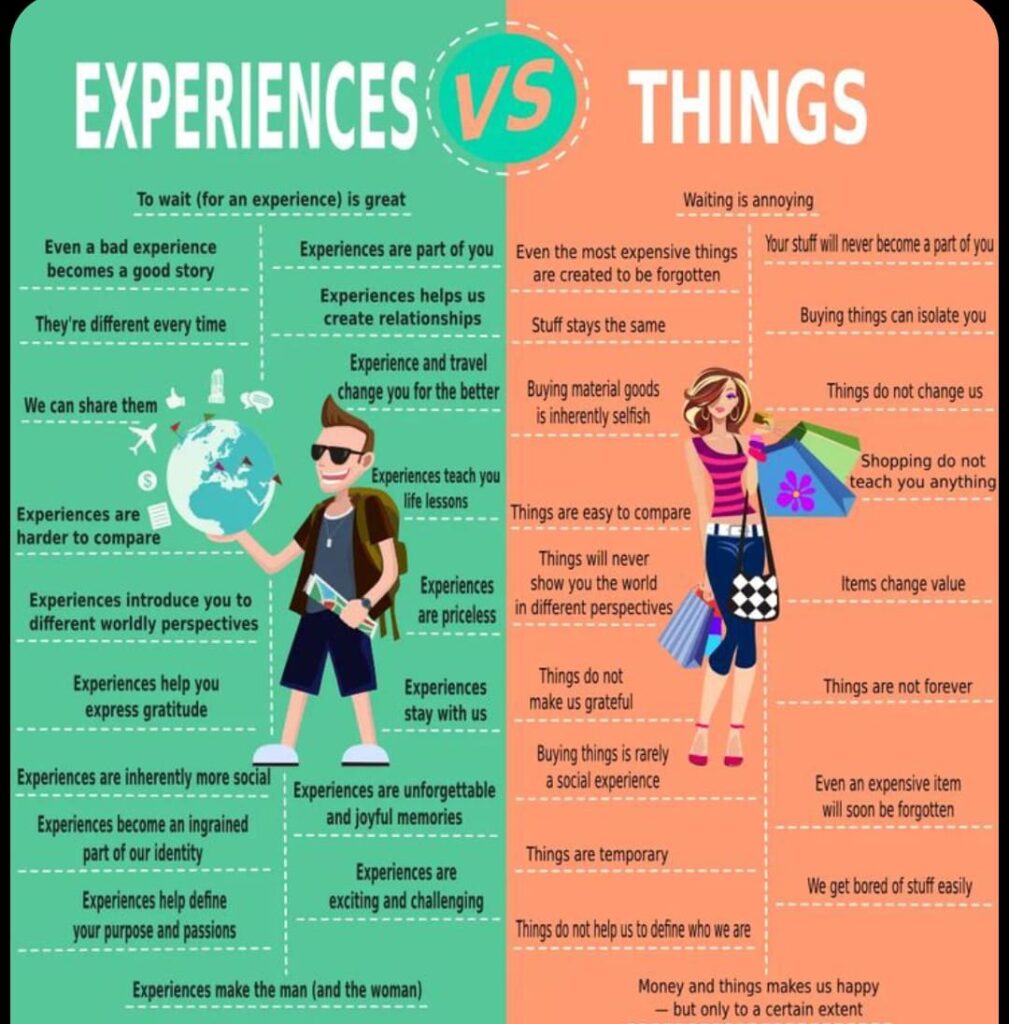
Research by Gilovich and colleagues published in Psychological Science found that people were happier at times when they were thinking about a future experiential purchase than they were at times when they weren’t thinking about a purchase at all. There was no relative increase or decrease in happiness when they were thinking about a future material purchase.
This finding is striking. Anticipating a material purchase produces no measurable happiness benefit beyond your baseline. Anticipating an experience — a holiday, a concert, a restaurant reservation, an outdoor adventure — produces genuine, measurable positive affect above baseline, even before the experience begins.
Researchers found that waiting for an experience tends to be more pleasant than waiting to receive a material good. The act of actually waiting in line for an experience may be more pleasant for those intending to buy access to an experience than a material acquisition.
The mechanism involves the imagination’s engagement with anticipated experiences. Experiences are rich with social, sensory, and narrative anticipation — you imagine who will be there, how it will feel, what will happen. Material objects are imagined as simply owned — which generates less imaginative engagement and correspondingly less anticipatory pleasure.
Phase 2 — Moment-to-Moment Happiness: Experiences Win During Consumption
Recent scholarship confirms that spending on experiences advances happiness more in the moment than spending on material items. In large-scale experience sampling studies, happiness was higher for all experiential categories than all material categories at the moment of consumption.
The greater hedonic return on experiential purchasing extends across a broad time course — experiences can make consumers feel happy even before they have felt the sand between their toes, taken their first sip, or heard the opening tune in a setlist.
The moment-to-moment happiness advantage of experiences is partly explained by the social connection they generate. Research published in Journal of Behavioral Decision Making in 2024 found that experiential purchases promote significantly more social connection than material purchases — and social connection is one of the most consistent predictors of in-the-moment positive affect.
Phase 3 — Remembered Happiness: Experiences Win Long After They End
The most durable happiness advantage of experiences occurs in memory — and this is where the difference between experiences and possessions is most pronounced. There is considerable evidence that experiential purchases provide more remembered happiness and enduring satisfaction than material purchases.
Material objects exist in the present as static possessions. Experiences exist in memory as dynamic narratives — stories that can be told, shared, revisited, and reinterpreted. Each telling reactivates the positive emotion of the original experience. Each sharing strengthens the social bonds formed during it. Each reinterpretation can extract new meaning from it.
The jacket you bought three years ago is simply your jacket. The trip you took three years ago is a story — one that still generates warmth, connection, and a sense of personal identity every time it is recalled.
The Neuroscience of Why Possessions Stop Making You Happy
Understanding why material purchases fail to sustain happiness requires understanding hedonic adaptation at the neurological level — and it is the central mechanism that makes the experiences-vs-things finding so robust.
Hedonic Adaptation — The Brain’s Happiness Reset Button
The brain’s reward system evolved to respond to change and novelty — not to sustained possession. When a new stimulus arrives — a new possession — the dopamine system fires in response to its novelty. As the possession becomes familiar, the dopamine response diminishes. Within weeks to months of acquiring most material goods, the pleasure they initially generated has largely dissipated — and the brain has recalibrated its baseline to include the possession as simply normal.
Gilovich’s research found that things like a new material purchase make you happy initially, but you adapt to it very quickly, and it doesn’t bring much joy thereafter. Experiential purchases don’t seem as subject to adaptation as material ones.
Why are experiences more resistant to hedonic adaptation? Because experiences are inherently unique and temporally bounded. You cannot habituate to a holiday in the way you habituate to a new sofa — because the holiday exists only in memory after it is over, and memories are not subject to the same diminishing novelty response as physical objects in your environment.
Social Comparison Resistance — Why Experiences Produce Less Envy
One of the most practically important findings in the experiences-vs-things research concerns social comparison — the mechanism through which material possessions so frequently generate envy and dissatisfaction rather than happiness.
The tendency of keeping up with the Joneses is more pronounced for material goods than for experiential purchases. It’s easier to feature-compare material goods than experiences. Spending money on experiences can decrease envious behaviour, which means people tend to be healthier and happier as a result.
Material goods are directly comparable — your television is measurably better or worse than your neighbour’s. Your holiday in Lisbon is simply different from your colleague’s holiday in Tokyo. Experience comparison is qualitatively richer and quantitatively less precise — making it significantly less productive of the social comparison pain that material goods so reliably generate.
Experiential Identity — Experiences Become Part of Who You Are
Our experiences are a bigger part of ourselves than our material goods,” says Gilovich. “You can really like your material stuff. You can even think that part of your identity is connected to those things, but nonetheless they remain separate from you. In contrast, your experiences really are part of you.
This identity integration mechanism is one of the most important reasons experiences resist hedonic adaptation. When an experience becomes part of your personal narrative — part of how you understand who you are and how you got here — it does not simply sit in memory as a pleasant recollection. It becomes part of the self-story that you carry, reinterpret, and derive meaning from across decades.
The Hedonic Variety Finding — The 2024 Update Nobody Is Covering
Research published in PMC in 2024 added an important nuance to the experiences-vs-things literature: variety in experiential spending produces significantly greater wellbeing than equivalent spending on the same experience repeatedly.
Hedonic spending variety was uniquely associated with wellbeing, even after controlling for total hedonic spending and other financial variables. This counter-effect occurs because people adapt more slowly to varied, surprising, and novel stimuli. Furthermore, buying experiences makes people happier than buying possessions partly because experiences involve relatively greater social connection.
The practical implication is that the strongest experiential spending strategy involves both choosing experiences over possessions AND varying the types of experiences — rather than spending on the same favoured experience repeatedly. Novelty within experiential spending sustains the anti-adaptation benefit that makes experiences superior to possessions in the first place.
Experience Categories Ranked by Happiness Return
Not all experiences produce equivalent happiness returns — and understanding which categories produce the strongest wellbeing benefits allows the most strategic experiential spending decisions.
Research across the Gilovich corpus and related studies identifies the following experience categories in approximate order of happiness return:
1. Shared social experiences — travel, dining, concerts, events experienced with others. The social connection dimension amplifies every happiness benefit of experiential spending. Experiences shared with others generate stronger oxytocin-mediated bonding, richer narrative memory, and more frequent retelling than solo experiences.
2. Novel and growth-oriented experiences — learning a new skill, visiting an unfamiliar place, engaging with an unfamiliar cultural context. Novelty maximises the anti-adaptation benefit of experiential spending and generates the identity expansion that produces eudaimonic alongside hedonic wellbeing.
3. Nature-based experiences — outdoor activities, hiking, wild swimming, time in natural environments. Nature exposure produces direct cortisol reduction and parasympathetic nervous system activation independently of the experiential spending mechanism — making nature-based experiences doubly effective wellbeing investments.
4. Physically active experiences — sport, dance, outdoor adventure. Physical activity produces endorphin, dopamine, and BDNF simultaneously — overlaying the experiential happiness mechanism with the direct neurochemical benefits of movement.
5. Culturally or intellectually engaging experiences — theatre, museums, exhibitions, live music, literary events. These generate eudaimonic wellbeing through meaning-making and intellectual engagement alongside the standard experiential happiness benefit.
A Practical Framework — How to Shift Toward Experiential Spending
1. Apply the Deathbed Test Before Major Purchases
Before any significant discretionary purchase, ask: “In 30 years, which will I remember more vividly and more warmly — this possession or an equivalent experience?” Research consistently confirms that people regret uncollected experiences far more than unpurchased possessions in retrospective wellbeing assessments.
2. Convert Material Impulses Into Experiential Alternatives
When the impulse to buy something arises, pause and ask whether an experience could fulfil the same underlying need more durably. The desire for a new kitchen gadget might be the desire for novelty in daily life — which a cooking class could satisfy far more completely and far more lastingly.
3. Prioritise Shared Experiences Over Solo Ones
Given that the social connection mechanism amplifies experiential happiness significantly, consistently choosing shared experiences — inviting a friend, family member, or colleague — over solo ones maximises the wellbeing return on experiential spending. Our loneliness guide covers the science of why shared experiences matter so profoundly for sustained wellbeing.
4. Build Variety Into Your Experiential Spending Deliberately
Based on the 2024 hedonic variety research, actively vary the types of experiences you invest in — rather than repeatedly choosing the same favoured restaurant, holiday destination, or activity. Variety sustains the anti-adaptation benefit that makes experiential spending superior to material spending in the first place.
5. Savour the Anticipation Deliberately
Given that anticipating an experience produces measurable happiness above baseline — while anticipating a material purchase does not — deliberately extending and savouring the anticipation phase of experiential purchases amplifies their total happiness return. Talk about the upcoming experience. Imagine it in sensory detail. Let the anticipation be a happiness resource rather than simply a waiting period.

Buying Experiences vs Things — Key Takeaways
The complete evidence-based summary:
The strongest experience categories for happiness are: shared social experiences, novel and growth-oriented experiences, nature-based experiences, physically active experiences, and culturally engaging experiences
Happiness is higher for all experiential purchase categories than all material categories at every phase of the purchase cycle
Experiences produce a three-phase happiness advantage: anticipatory happiness before they occur, moment-to-moment happiness during consumption, and remembered happiness indefinitely afterward
Material purchases are subject to rapid hedonic adaptation — the brain’s novelty response diminishes within weeks, leaving possessions as simply normal background
Experiences resist hedonic adaptation because they exist in memory as narratives rather than in the environment as objects — and memories can be shared, retold, and reinterpreted without losing their emotional charge
Social comparison is significantly less painful for experiences than possessions — because experiences resist direct feature comparison
Experiences become part of personal identity in ways that possessions do not — generating eudaimonic alongside hedonic wellbeing
Hedonic variety in experiential spending — varying the types of experiences chosen — produces greater wellbeing than equivalent spending on the same experience repeatedly
Shared experiences produce the strongest happiness returns — because social connection amplifies every experiential happiness mechanism
A Word From mindnesto
At mindnesto, we find the experiences-vs-things research genuinely liberating — because it replaces the arbitrary cultural assumption that more possessions equal more wellbeing with something far more specific, far more accurate, and far more actionable.
You do not need more things. You need more experiences — specifically, shared, novel, and varied experiences that resist the adaptation that makes possessions so consistently disappointing over time.
The next time you face a spending decision between a possession and an experience, the science is clear about which choice will make you happier — not just today, but next year, and in the decades of memory that follow. Buy the trip. Attend the concert. Take the class. Go for the walk with someone you love.
That is where the happiness lives. 💙
→ Read next: Can Money Buy Happiness? The Complete Science
→ Also read: Prosocial Spending — Why Giving Makes You Happier
Frequently Asked Questions
Why do experiences make you happier than things?
Experiences produce greater happiness than material possessions because they resist hedonic adaptation — the brain’s tendency to habituate to new stimuli — through three mechanisms: they generate anticipatory happiness before they occur, in-the-moment happiness that exceeds equivalent material consumption, and remembered happiness indefinitely afterward through narrative memory. Material possessions activate primarily the present moment of pleasure, which adaptation rapidly neutralises.
Does this apply to all types of experiences?
Research finds that experiences produce greater happiness than possessions across all experience categories studied — including travel, concerts, dining, outdoor activities, and entertainment. Within experiences, shared social experiences, novel and growth-oriented experiences, and nature-based experiences produce the strongest happiness returns.
What is hedonic adaptation and why does it limit happiness from possessions?
Hedonic adaptation is the brain’s universal tendency to return to a baseline happiness level following positive changes in circumstance. The reward system evolved to respond to novelty — when a new possession becomes familiar, the dopamine response to it diminishes and the object becomes simply normal background.
Is it better to spend on a shared experience or a solo one?
Shared experiences consistently produce greater happiness returns than equivalent solo experiences — because the social connection mechanism amplifies every component of experiential happiness. Research published in Journal of Behavioral Decision Making in 2024 confirmed that experiential purchases promote significantly more social connection than material purchases — and social connection is one of the most consistent predictors of moment-to-moment positive affect and long-term wellbeing.
How do I know which experiences will make me happiest?
Research identifies five experience categories in approximate order of happiness return: shared social experiences with people you genuinely enjoy, novel and growth-oriented experiences outside your normal routine, nature-based experiences in outdoor or natural settings, physically active experiences combining movement and engagement, and culturally or intellectually stimulating experiences. Within each category, variety.
Sources and External References
- ScienceDirect — A Wonderful Life: Experiential Consumption and Happiness
- ScienceDirect — Unmatchable Brightness of Doing: Experiential vs Material 2022
- ScienceDirect — Spending on Doing vs Having 2020
- PMC — Hedonic Spending Variety and Wellbeing 2024
- Cornell University — Doing Makes You Happier Than Owning
- Cornell University — Glee From Buying Objects Wanes
- APS — Anticipating Experience-Based Purchases
- Entrepreneur — 7 Reasons Experiences Make You Happier
- APA — Happiness and Consumer Psychology
- Greater Good Science Center — Why Experiences Beat Stuff
- NHS — Mental Wellbeing
- Mind UK — Wellbeing
- NHS Talking Therapies
- ADAA USA
- CAMH Canada
- Beyond Blue Australia