






By mindnesto Editorial Team · Updated June 2026 · 9 min read
Sources cited from APA, Psychological Science, Journal of Personality and Social Psychology, ScienceDirect and peer-reviewed happiness psychology research
Think about the last time you really wanted something. Not a passing impulse — but a genuine, sustained desire. The holiday you planned for months. The salary you worked toward for years. The relationship you finally felt ready for. The home you stretched your budget to afford.
Now think about how you feel about each of those things today.
If you are like most people, the honest answer involves a noticeable gap between the happiness you anticipated and the happiness you received — and between the happiness you received initially and the happiness you feel about the same things now. That gap has a name. It has a mechanism. And understanding it may be one of the most liberating things you encounter in the science of happiness.
Hedonic adaptation is the universal psychological tendency to return to a relatively stable baseline level of happiness following positive or negative life changes — regardless of how significant those changes are. It is the process by which what initially delights becomes simply normal. And it is the central mechanism that explains why income growth, material acquisition, and most conventional happiness strategies produce real but temporary gains that quietly disappear.
Hedonic adaptation is defined as the process by which individuals become accustomed to emotional stimuli, leading to a gradual return to baseline levels of wellbeing after experiencing positive or negative events.
This guide covers the complete science — where hedonic adaptation comes from, why it evolved, what it means for every major life decision you make, what specifically resists it, and the evidence-based strategies that genuinely slow it down.
We have connected this to our can money buy happiness guide, our buying experiences vs things guide, and our prosocial spending guide — because hedonic adaptation is the foundational mechanism that explains why the money-happiness relationship works the way the research shows it does.
Note: This article is for general informational and educational purposes.
What Is Hedonic Adaptation?
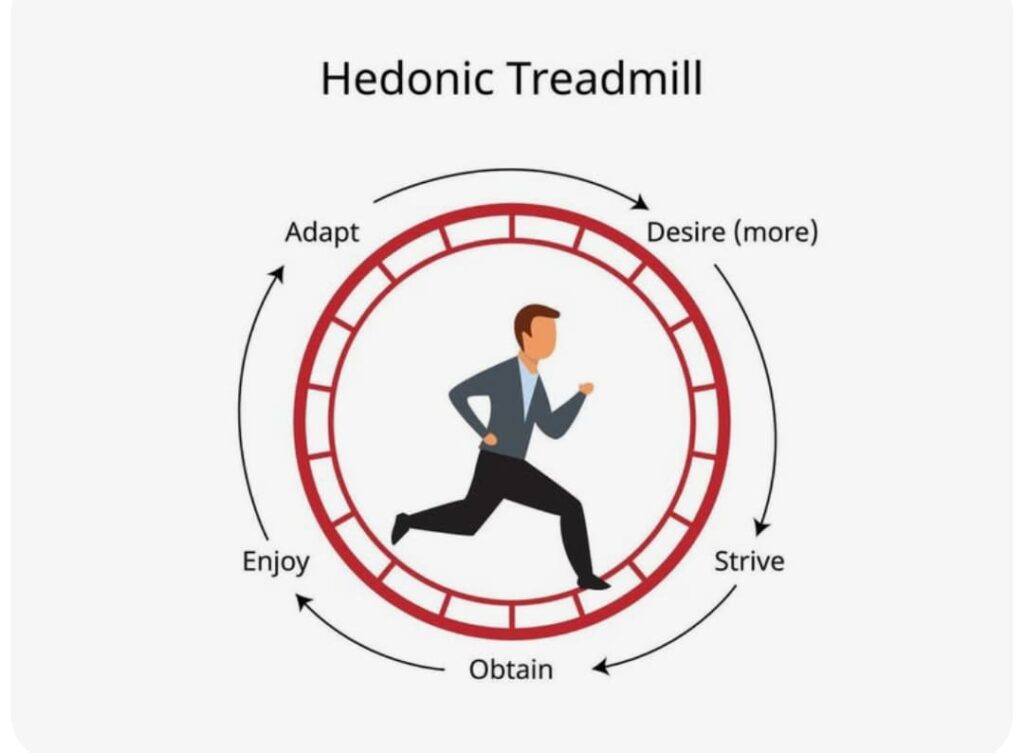
The direct answer: Hedonic adaptation is the psychological process by which people return to a stable baseline happiness level after both positive and negative life changes. Originally described as the “hedonic treadmill” — a term coined by psychologists Philip Brickman and Donald Campbell in 1971 — it proposes that people continuously return to the same level of happiness regardless of what happens to them. More recent research has revised this model: adaptation is real and powerful, but it is not always complete, and certain experiences and activities resist it more effectively than others.
The concept was dramatically illustrated in Brickman’s most famous study — comparing lottery winners and paraplegics with a control group. Both groups, one year after their life-changing event, reported happiness levels closer to the control group than to what their extreme circumstances might predict. Lottery winners were not as happy as expected. Paraplegics were not as unhappy as expected. Both had adapted — powerfully and rapidly — toward their baseline.
The Science of Hedonic Adaptation — Where It Comes From
The Evolutionary Purpose of the Hedonic Treadmill
Hedonic adaptation did not emerge as a psychological flaw. It evolved as a highly adaptive survival mechanism — and understanding its original purpose makes its modern consequences far less frustrating.
The brain’s reward system evolved to motivate behaviour in service of survival — finding food, avoiding danger, reproducing, maintaining social bonds. A reward system that habituated to achieved goals was more effective for survival than one that remained satisfied with the status quo — because habituated rewards maintained the motivation to keep seeking, improving, and adapting.
Hedonic adaptation may have developed to serve functions similar to those of other forms of adaptation — limiting the detrimental physical effects of repeated intense feelings such as stress, and dampening motivational signals when they are not very useful for informing behaviour. In evolutionary terms, the hedonic treadmill was a feature, not a bug. In modern consumer culture, where it drives continuous material aspiration without corresponding wellbeing gains, its consequences are considerably more complicated.
Adaptation Level Theory — The Original Framework
Harry Helson’s adaptation level theory — first published in 1964 — provided the psychological foundation for understanding hedonic adaptation. Helson proposed that people judge stimuli relative to an adaptation level — a moving average of their past experiences — rather than in absolute terms.
Applied to happiness, this means that your current happiness is always assessed relative to your recent experience baseline. As your circumstances improve and your baseline rises, equivalent circumstances produce less happiness than they would have produced before the improvement. The treadmill metaphor is apt: you walk faster, but you stay in the same place.
The Revised Set Point Theory — Adaptation Is Real But Not Complete
The classical hedonic treadmill model predicted complete adaptation — the eventual return to exactly the same happiness baseline regardless of circumstance. Later research has significantly revised this view. The empirical evidence suggests that although wellbeing is stable for most people, lasting changes are nevertheless possible — and recent theoretical developments including the revised set point theory, wellbeing homeostasis theory, and the hedonic adaptation prevention model offer different explanations for these findings.
Professor Ed Diener of the University of Illinois and colleagues found that while most people return toward their pre-event wellbeing level following major life changes, the return is frequently incomplete — and some events produce lasting wellbeing changes that do not fully adapt. The practical implication is significant: hedonic adaptation is powerful, but it is not destiny. It can be slowed, prevented, and — for certain types of experience — substantially bypassed.
What People Adapt To — And What They Do Not
Research on adaptation has revealed a striking pattern: the things most heavily marketed as happiness-producers are precisely those to which people adapt most completely. Meanwhile, the things that resistance to adaptation most effectively are precisely those that consumer culture systematically undervalues.
People adapt rapidly and completely to:
- Material possessions — new technology, clothing, cars, home improvements
- Income increases — within 12 months of a significant salary rise, most people have largely returned to their pre-raise baseline
- Physical appearance changes — cosmetic improvements produce temporary happiness gains that adapt quickly
- Status acquisitions — promotions, awards, social recognition — powerful initially, habituated rapidly
People adapt slowly or incompletely to:
- Chronic negative circumstances — noise pollution, long commutes, chronic pain show slower and less complete adaptation than positive circumstances
- Social connection — the happiness that genuine, deep relationships provide shows the most resistance to adaptation of any happiness source identified in research
- Meaning and purpose — work and activities experienced as genuinely meaningful show significantly slower adaptation than hedonic pleasure
- Variety and novelty — new, surprising, and varied experiences resist adaptation more effectively than repeated familiar ones
- Contribution to others — prosocial behaviour produces happiness that adapts more slowly than equivalent self-directed consumption
This is the single most important practical insight from hedonic adaptation research. The experiences that resist adaptation are almost precisely those that the cluster blogs in this series — experiences over things, prosocial spending, time affluence — have identified as the most reliable happiness investments. The research converges on the same conclusion from multiple directions.
The Hedonic Adaptation Prevention Model — Lyubomirsky’s Framework
The most practically useful research development in hedonic adaptation science is the Hedonic Adaptation Prevention (HAP) Model developed by Professor Sonja Lyubomirsky of the University of California Riverside and Kennon Sheldon of the University of Missouri.
The HAP model identifies two primary mechanisms through which hedonic adaptation can be slowed or prevented:
Mechanism 1 — Sustained positive emotions: Activities and circumstances that continuously generate positive emotional responses — rather than producing a single positive event that then becomes normal — resist adaptation because there is no stable new baseline for the brain to adapt to. Relationships, meaningful work, and purposeful activities produce this continuous positive emotion more effectively than material goods.
Mechanism 2 — Sustained positive construal: The ways people think about their positive circumstances — the degree to which they appreciate, savour, and reflect on them — significantly influence how quickly they adapt. People who actively and regularly appreciate their good fortune adapt more slowly than those who take it for granted.
These two mechanisms point toward the specific strategies most effective for hedonic adaptation prevention.
8 Evidence-Based Strategies to Slow Hedonic Adaptation
1. Introduce Variety Into Positive Experiences Deliberately
Variety is the single most powerful anti-adaptation strategy — because the brain cannot habituate to stimuli that keep changing. Research confirms that variety in experiential spending produces significantly greater wellbeing than equivalent spending on the same experience repeatedly. Apply this principle across every domain of positive experience — varying the routes you walk, the meals you cook, the activities you pursue, the ways you express appreciation in relationships.
2. Practise Savoring — Deliberately and Specifically
Savoring — the deliberate, conscious engagement with positive experiences as they occur — is one of the most evidence-based anti-adaptation strategies available. Research by Fred Bryant of Loyola University Chicago found that savoring — pausing to notice, appreciate, and fully engage with positive experiences as they happen — significantly slows adaptation by preventing the transition from active appreciation to passive background normality.
Specific savoring practices: pause during positive moments to consciously acknowledge them, share positive experiences with others immediately after they occur, photograph moments of genuine positive experience to create savoring cues for later review, and write about positive experiences in specific sensory and emotional detail.
3. Use Gratitude Practice as Anti-Adaptation Infrastructure
Gratitude — specifically, the deliberate recall and appreciation of existing positive circumstances — directly counteracts the adaptation process by repeatedly reactivating the positive emotional response to circumstances that would otherwise simply be taken for granted.
Research by Robert Emmons of UC Davis and Michael McCullough of the University of Miami found that weekly gratitude journaling produced significantly greater wellbeing, life satisfaction, and positive affect than control conditions — through the mechanism of sustained positive construal that Lyubomirsky’s HAP model identifies as one of the two primary adaptation prevention mechanisms.
Gratitude practice is most effective when it is specific — gratitude for a particular person’s specific action, for a specific experience, for a precise fortunate circumstance — rather than general thankfulness that itself habituates rapidly.
4. Choose Experiences Over Possessions — Now You Know Why
The experiences-vs-things finding — covered in depth in our buying experiences vs things guide — is most completely understood through the lens of hedonic adaptation. Experiences resist adaptation more effectively than possessions because they exist in memory rather than in the physical environment, and memories do not become simply normal in the way that objects do.
Every time you choose an experience over a possession, you are applying the most evidence-based anti-adaptation spending strategy available.
5. Invest in Social Connection — The Most Adaptation-Resistant Happiness Source
Social connection — genuine, deep, reciprocal human relationships — shows the most resistance to hedonic adaptation of any happiness source identified in research. The Harvard Study of Adult Development, which followed participants for over 85 years, found that relationship quality was the single strongest predictor of both happiness and physical health at every life stage.
Why does social connection resist adaptation? Because relationships are inherently dynamic — they change, develop, deepen, and surprise in ways that material possessions and even many experiences cannot replicate. Each genuine interaction with someone you love is different from the last in ways that prevent the stable habituation that adaptation requires.
Investing consistently in the relationships that matter most to you — through time, attention, and the prosocial generosity covered in our prosocial spending guide — is the most durable anti-adaptation happiness strategy available.
6. Pursue Meaning Rather Than Pleasure
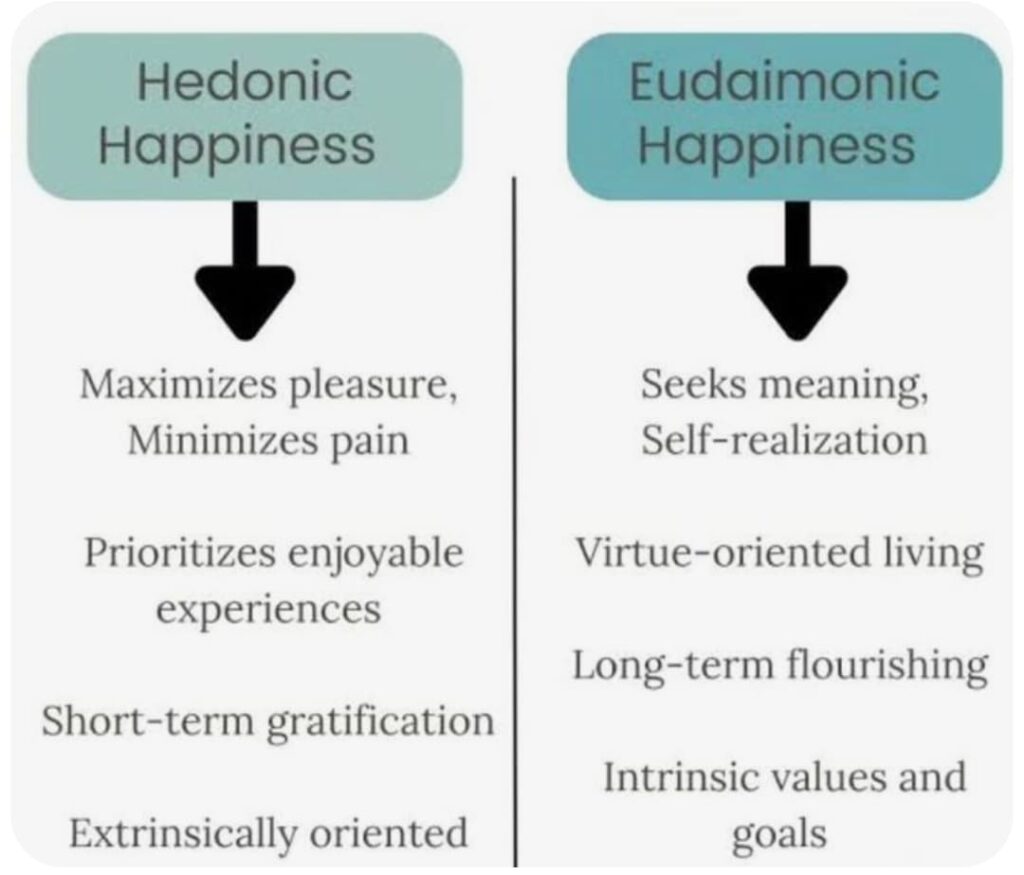
Eudaimonic wellbeing — the happiness that comes from meaning, purpose, and living in alignment with your values — adapts more slowly than hedonic wellbeing — the happiness that comes from pleasure and positive affect. Work and activities experienced as genuinely meaningful generate positive emotions that are continuously renewed by the ongoing significance of the contribution — rather than produced once and then habituated.
The practical implication is one of the most consistent findings in positive psychology: invest in activities that feel meaningful, not just pleasant. The pleasure of a new purchase adapts within weeks. The satisfaction of meaningful work, contribution, and purpose sustains itself through the continuous renewal of its significance.
7. Interrupt Positive Experiences Deliberately
One of the most counterintuitive anti-adaptation findings comes from research by Leif Nelson of Berkeley and Tom Meyvis of NYU: deliberately interrupting positive experiences — pausing partway through something enjoyable and then resuming — significantly increases the total enjoyment of the experience.
The mechanism involves resetting the adaptation level within the experience — the pause brings attention back to the initial positive novelty that the interrupted experience produced, preventing the smooth transition into habituated acceptance that uninterrupted consumption produces.
8. Give Away What You Have Before You Have Fully Adapted to It
Based on the prosocial spending research covered in our prosocial spending guide, one of the most effective anti-adaptation strategies is redirecting resources — time, money, and attention — toward others before you have fully adapted to having them yourself.
Giving generates the warm glow, oxytocin-mediated bonding, and social connection that resist adaptation most effectively — while simultaneously preventing the material accumulation cycle that adaptation makes endlessly unsatisfying.
Hedonic Adaptation Key Takeaways — Featured Snippet
The complete evidence-based summary:
- Hedonic adaptation is the universal tendency to return to a baseline happiness level following positive or negative life changes — the “hedonic treadmill”
- First identified by Brickman and Campbell in 1971 — demonstrated most dramatically by the finding that lottery winners and paraplegics show similar happiness levels one year after their life-changing events
- Adaptation evolved as a survival mechanism — maintaining motivation by habituating to achieved goals and creating drive to continue seeking
- The revised set point theory confirms that adaptation is powerful but not always complete — lasting happiness changes are possible through targeted strategies
- Material possessions are among the most rapidly and completely adapted-to happiness sources — income gains adapt within approximately 12 months
- Social connection, meaning, and variety are the most adaptation-resistant happiness sources — explaining why relationship quality predicts long-term happiness more reliably than income
- The Hedonic Adaptation Prevention Model (Lyubomirsky and Sheldon) identifies sustained positive emotions and sustained positive construal as the two primary adaptation prevention mechanisms
- Variety is the single most powerful anti-adaptation strategy — the brain cannot habituate to continuously changing stimuli
- Savoring — deliberate, conscious engagement with positive experiences as they occur — significantly slows the transition from active appreciation to passive background normality
- Gratitude practice prevents adaptation by repeatedly reactivating positive emotional responses to circumstances that would otherwise be taken for granted
- Experiences resist adaptation more effectively than possessions — because memories do not become simply normal in the way that objects do
A Word From mindnesto
At mindnesto, we believe that understanding hedonic adaptation is genuinely liberating — not because it says happiness is impossible, but because it identifies precisely where conventional happiness strategies fail and where evidence-based ones succeed.
The hedonic treadmill is not your enemy. It is a feature of a human nervous system that evolved for survival in conditions very different from modern life. Understanding it allows you to work with your biology rather than against it — choosing the experiences, connections, and activities that resist adaptation most effectively, and practising the savoring, gratitude, and variety that slow it down.
You are not stuck on the treadmill. You are simply not yet off it. And the research shows exactly how to step off. 💙
→ Read next: Can Money Buy Happiness? The Complete Science
→ Also read: Buying Experiences vs Things — Why Science Says Buy the Trip
Frequently Asked Questions
What is hedonic adaptation?
Hedonic adaptation is the psychological process by which people return to a stable baseline happiness level following positive or negative life changes. The brain’s reward system habituates to new stimuli — producing the initial pleasure of novelty followed by a gradual return to the happiness baseline that existed before the change.
Why does hedonic adaptation happen?
Hedonic adaptation evolved as a survival mechanism — maintaining the motivation to keep seeking, improving, and adapting by habituating to achieved goals rather than remaining permanently satisfied with the status quo.
What do people not adapt to?
Research identifies social connection and genuine relationships, meaningful work and purposeful activity, and variety and novelty as the happiness sources most resistant to hedonic adaptation. Material possessions, income gains, status acquisitions, and physical appearance changes show rapid and relatively complete adaptation.
How do I stop adapting to happiness?
The most evidence-based anti-adaptation strategies include: introducing deliberate variety into positive experiences to prevent stable habituation, practising savoring — conscious, specific engagement with positive experiences as they occur — to prevent passive normalisation, using gratitude practice to repeatedly reactivate positive responses to already-present circumstances, choosing experiences over possessions, investing in social connection and meaningful activity, and giving away resources before fully adapting to having them. No strategy prevents adaptation entirely — but these consistently slow it significantly.
Does hedonic adaptation apply to relationships?
Social connection and genuine relationships show the most resistance to hedonic adaptation of any happiness source in research — but they are not entirely immune. Relationship quality requires continuous investment and renewal to maintain its adaptation resistance.
Sources and External References
- APA — Hedonic Treadmill Set Point Model
- ScienceDirect — Hedonic Adaptation Overview
- Psychology Today — Hedonic Treadmill May 2026
- Positive Psychology — How to Escape the Hedonic Treadmill 2025
- Semantic Scholar — Hedonic Adaptation and Set Point
- ResearchGate — Adaptation and the Set Point Model
- NBER — Hedonic Adaptation in Subjective Wellbeing
- PNAS — Explaining Happiness, Easterlin
- Journal of Personality and Social Psychology — Adaptation and Happiness
- APA — Happiness and Wellbeing
- Greater Good Science Center — Hedonic Adaptation
- NHS — Mental Health and Wellbeing
- Mind UK — Wellbeing
- NHS Talking Therapies
- ADAA USA
- CAMH Canada
- Beyond Blue Australia