







By mindnesto Editorial Team · Updated June 2026 · 10 min read
Reviewed for accuracy — sources cited from J Biomed Research Environmental Sciences 2026, Lumen Health Services August 2026, Thoughts on Life and Love September 2026, Reachlink August 2026 and peer-reviewed intimacy research
Most people approach emotional and physical intimacy as though they are two separate dimensions of a relationship — two dials that can be turned up or down independently of each other. Turn up the emotional dial through meaningful conversation and vulnerability. Turn up the physical dial through affection and sex. Manage them separately. Improve them separately.
This model is fundamentally wrong. And understanding why it is wrong is the key to understanding why intimacy in long-term relationships so often declines in both dimensions simultaneously — and why restoring one so reliably begins to restore the other.
Emotional and physical intimacy run on a loop. Feeling understood makes most people more open to touch. Touch releases oxytocin, which makes conversation feel safer. Break one side of the loop and the other side slows. This is not a metaphor about relationship dynamics. It is a description of measurable neurochemical reality — confirmed by a 2026 review published in the Journal of Biomedical Research and Environmental Sciences that found emotional and physical intimacy are essential for marital stability through measurable physiological mechanisms, with physical affection producing effects comparable to pharmacological interventions.
Understanding this loop changes everything about how you approach intimacy in a long-term relationship. It means that the most effective path to physical intimacy often runs through emotional safety — and that the most effective path to emotional openness often runs through physical warmth.
This guide covers the complete picture — the four types of intimacy, the neuroscience of the emotional-physical loop, what breaks it and what restores it, and 10 specific evidence-based strategies that strengthen both dimensions simultaneously.
We have connected this to our sex and intimacy pillar guide, our why intimacy decreases guide, and our secure attachment communication guide — because the emotional-physical intimacy loop, intimacy decline, and secure communication are three facets of the same relational reality.
Note: This article is for informational and educational purposes. Significant intimacy difficulties affecting your relationship or mental health warrant professional support from a qualified couples therapist or sex therapist.
What Is the Difference Between Emotional and Physical Intimacy?
Emotional intimacy is the feeling of being genuinely known and accepted by your partner — built through self-disclosure, trust, perceived partner responsiveness, and the consistent experience of having your emotional bids met with attention rather than dismissal. Physical intimacy is closeness through the body — ranging from holding hands and cuddling to sexual connection. In a healthy long-term relationship, the distinction between them is less important than the loop connecting them. Emotional intimacy makes people more open to physical closeness. Physical closeness releases oxytocin that makes emotional vulnerability feel safer. Each feeds the other — and damage to either damages both.
Emotional and physical intimacy are false opposites. In a long-term relationship, emotional vs physical intimacy is a false choice. Each one feeds the other, so the useful goal is to rebuild both at the same time.
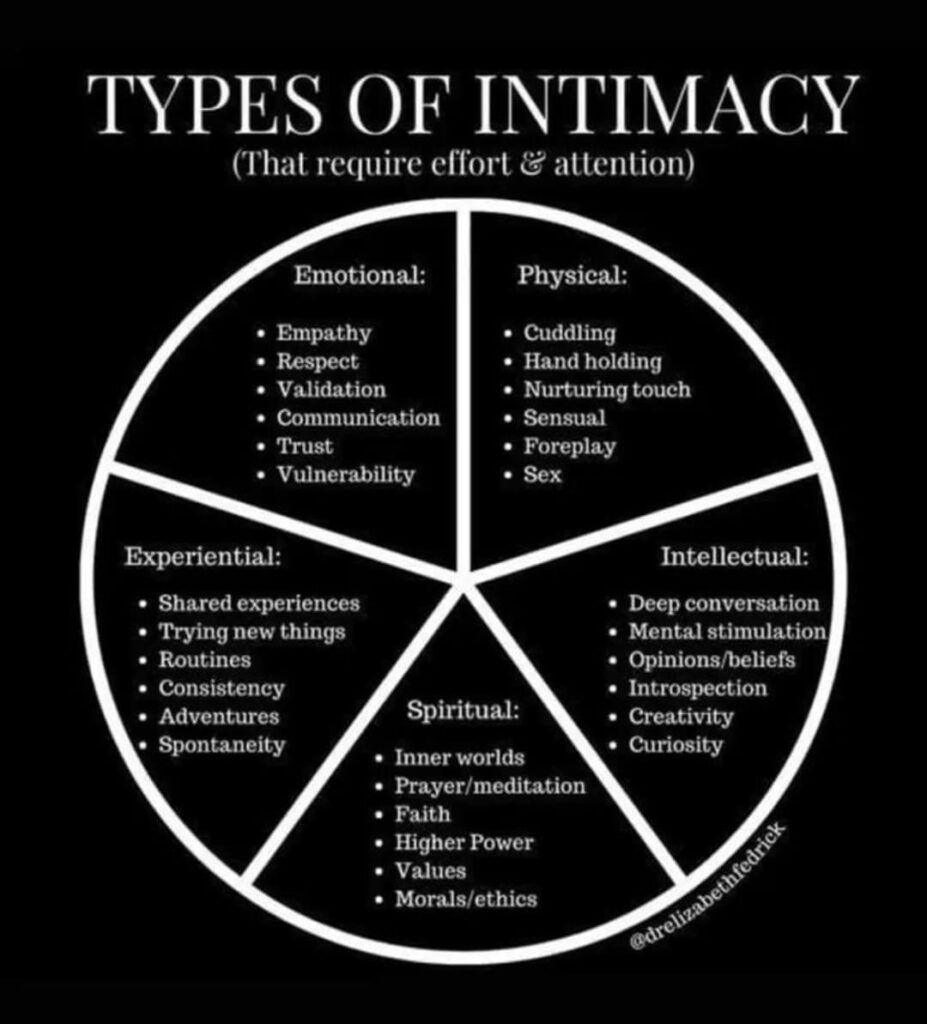
The Four Types of Intimacy — The Complete Framework
Most discussions of intimacy focus exclusively on emotional and physical dimensions. Relationship research identifies four distinct intimacy types — each with its own development pathway and its own contribution to overall relationship health.
1. Emotional Intimacy
Emotional intimacy is the experience of feeling genuinely known, accepted, and safe with another person. Research by Harry Reis and Phillip Shaver — published in 1988 and still the foundational framework in intimacy science — defines emotional intimacy through four core components: self-disclosure (openly sharing thoughts, feelings, and vulnerabilities), trust (believing in each other’s reliability and support), responsiveness (actively listening and acknowledging the other’s emotional experience), and validation (affirming and respecting each other’s experiences).
A 2022 survey by the Relationship Research Institute found that 85% of respondents agreed that emotional intimacy was the key to a successful long-term partnership. Couples who actively practise emotional intimacy also tend to experience lower stress levels and better conflict resolution — confirming its role as both a relationship quality predictor and a mental health protective factor.
Emotional intimacy is not a state you reach and maintain permanently. It is a dynamic process that naturally fluctuates, even in healthy relationships. That fluctuation is not a sign something is wrong. It means emotional intimacy requires active, repeated engagement rather than a single moment of connection that is then assumed to persist.
2. Physical Intimacy
Physical intimacy encompasses all forms of closeness through the body — from holding hands, cuddling, and massage through to sexual connection. It is significantly wider than sex alone — and this breadth is clinically important because it means physical intimacy can be maintained, deepened, and restored through non-sexual physical affection even during periods when sexual intimacy is less available or less desired.
Research by Gulledge and colleagues found that increased physical affection correlates with greater relationship satisfaction — strengthening trust and emotional wellbeing independently of its sexual dimension. The 2026 Journal of Biomedical Research and Environmental Sciences review found that physical affection produces neurochemical effects — oxytocin, dopamine, serotonin, and endorphin release combined with cortisol reduction — comparable in magnitude to pharmacological interventions for stress and mood.
Physical affection has effects similar to pharmacological interventions. This finding positions physical intimacy not simply as a relationship enrichment activity but as a genuine mental health intervention with measurable neurobiological mechanisms.
3. Intellectual Intimacy
Intellectual intimacy is the connection that develops through shared thinking — engaging in deep conversations, exploring ideas together, debating perspectives, and learning alongside each other. It builds a unique bond that adds depth and richness to a partnership beyond the emotional and physical dimensions. Couples who experience intellectual intimacy report feeling genuinely interested in their partner as a person — not simply comfortable with them.
Intellectual intimacy is particularly relevant for long-term relationship vitality because it is highly resistant to the hedonic adaptation that affects physical and even emotional intimacy over time. Genuine intellectual engagement with another person’s mind produces the novelty and discovery that sustained intimate interest requires.
4. Psychological Intimacy
Psychological intimacy involves the development of deep trust and a genuine sense of security within the relationship. Unlike emotional intimacy — which is built through shared feeling — psychological intimacy is built through the consistent experience of being reliably supported, consistently understood, and genuinely safe from judgment within the relationship.
Psychological intimacy corresponds most closely to what attachment theory identifies as secure attachment — the felt sense that the relationship is a safe base from which both partners can explore the world and a safe haven to which both can return during difficulty. Our secure attachment communication guide covers the specific communication practices that build this psychological security in depth.
The Neuroscience of the Emotional-Physical Loop
Why Emotional Safety Is the Prerequisite for Physical Intimacy
The most important 2026 neuroscience insight about emotional and physical intimacy comes from the application of Polyvagal Theory to intimate relationships. As covered in our pillar guide, the ventral vagal pathway — the neurological state of genuine felt safety — is the prerequisite for both genuine emotional vulnerability and genuine physical arousal.
When the nervous system registers threat — through unresolved conflict, felt criticism, emotional distance, or accumulated resentment — it shifts from the social engagement state that allows both emotional and physical openness into a defensive state that suppresses both. This explains the familiar experience of emotional or physical distance persisting even after a conflict has technically been resolved. The nervous system requires felt safety — not simply cognitive resolution — before either emotional or physical intimacy can fully re-activate.
Unresolved conflict is not separate from the bedroom. It shows up there. And this is not simply a psychological observation. It is a neurological one.
Why Emotional Exposure Feels Physically Dangerous
One of the most important neuroscience findings for understanding the emotional intimacy barrier comes from research by Naomi Eisenberger and Matthew Lieberman of UCLA. Their neuroimaging studies demonstrated that social rejection activates the same neural circuits as physical pain — specifically the dorsal anterior cingulate cortex and the anterior insula that process the distressing component of physical pain.
The brain is not being dramatic when it treats emotional exposure as a threat. It is processing the possibility of social rejection through the same neural architecture it uses for physical injury — because for most of human evolutionary history, social exclusion was as dangerous as physical harm.
This finding explains why emotional intimacy frequently feels more frightening than physical intimacy — even in established relationships. Physical vulnerability has clear limits that can be managed. Emotional vulnerability exposes the inner self to rejection in ways that activate the pain system. Understanding this removes the character judgement from difficulty with emotional vulnerability and places it in its neurological context.
The Oxytocin Bridge — How Physical Touch Opens Emotional Space
The most practically important aspect of the emotional-physical loop is the oxytocin mechanism that allows physical touch to open emotional space. Non-sexual physical affection — cuddling, hand-holding, massage, extended embraces — activates oxytocin release in both partners. Oxytocin reduces cortisol, activates the ventral vagal pathway, and produces the felt sense of safety that makes emotional vulnerability neurologically less threatening.
This is why the sequence matters. For couples whose emotional intimacy has declined, rebuilding through conversation alone often feels effortful and exposed — because the cortisol-elevated state of emotional distance suppresses the safety that honest conversation requires. Rebuilding through physical warmth first — through non-sexual affection that activates the oxytocin-ventral vagal mechanism — creates the neurological conditions in which emotional conversation becomes genuinely possible rather than merely attempted.
The Sue Johnson EFT Framework — The Loop in Clinical Practice
Dr. Sue Johnson’s Emotionally Focused Therapy treats the emotional-physical intimacy loop as the core of couples work. EFT specifically identifies that sexual desire follows a similar pattern to emotional intimacy — with responsive desire arriving after emotional safety is established rather than preceding it. Many long-term partners stop waiting for spontaneous desire that no longer shows up — and never start the kind of emotional contact that would create the safety from which physical desire could emerge.
EFT’s central insight is that physical intimacy and emotional intimacy are not parallel tracks to be improved separately. They are a single loop — and entry into the loop at either point, with appropriate neurobiological support, restores movement in both directions simultaneously.
The Divorce Statistics — Why Both Dimensions Matter
The 2026 Journal of Biomedical Research and Environmental Sciences review on emotional and physical intimacy in couples provides the most compelling statistical argument for taking both dimensions seriously.
Rising divorce rates globally represent a significant social concern. Among many reasons, poor communication accounts for 38% of divorces — making it the single most common structural cause. Sexual dissatisfaction represents a very high critical contributing factor alongside this.
These two statistics sit at exactly the intersection of emotional and physical intimacy. Poor communication is a failure of emotional intimacy — the self-disclosure, responsiveness, and validation that sustain felt connection between partners. Sexual dissatisfaction is a failure of physical intimacy — compounded, in most cases, by the emotional distance that precedes or accompanies it.
Both statistics confirm that emotional and physical intimacy are not peripheral relationship features. They are the structural load-bearing elements on which relationship stability rests — and their simultaneous decline is the most reliable predictor of relationship dissolution available in the research.
What Breaks the Emotional-Physical Intimacy Loop
The Small Moments — How Most Couples Actually Lose Emotional Intimacy
Most couples do not lose emotional intimacy in arguments. They lose it in hundreds of small moments where nobody looked up. A comment about the news met with distraction. A sigh acknowledged with silence. A vulnerability offered into a phone-filled room. Dr. John Gottman identifies these moments as emotional bids — any attempt to make emotional contact with a partner. Turning toward bids builds trust. Ignoring them drains it. The accumulated drain of consistently missed bids produces the emotional distance that then suppresses physical intimacy.
This is one of the most clinically important findings in relationship research — because it reframes the intimacy conversation away from dramatic interventions and toward daily attentiveness. Intimacy is not primarily lost in crises. It is lost in the slow accumulation of unwitnessed ordinary moments.
Logistics Taking Over — The Practical Intimacy Killer
Intimacy fades for practical reasons as much as psychological ones. Conversation becomes school runs, bills, and scheduling. The relationship’s communicative life contracts from shared inner worlds to shared logistical tasks — and the felt sense of being genuinely known by another person quietly disappears.
This practical dimension of intimacy decline is both the most common cause and the most addressable — because it does not require therapeutic intervention so much as deliberate reorientation of what couples talk about and how they spend shared time.
Mental Health as an Intimacy Suppressor
Mental health plays an important role in relationship satisfaction. Anxiety, depression, trauma, chronic stress, and burnout can all influence communication, emotional availability, and physical affection. A partner experiencing depression may withdraw socially or lose interest in activities they once enjoyed — including physical intimacy. Someone managing anxiety may find it difficult to relax, communicate openly, or feel emotionally present. These changes are not signs of personal failure or reduced love. Addressing underlying mental health through appropriate treatment improves both individual wellbeing and relationship intimacy simultaneously.
Our emotional intelligence guide covers the specific emotional regulation skills that most directly support emotional availability in relationships.
Attachment Style and Intimacy Patterns
Attachment style — formed in early relational experiences — shapes how both emotional and physical intimacy are experienced and expressed. Securely attached people generally find it easier to communicate openly and maintain healthy emotional connections. Anxiously attached partners may seek frequent reassurance and worry about rejection — suppressing the emotional vulnerability they most want through the anxiety it generates. Avoidantly attached partners may struggle with vulnerability or become uncomfortable as emotional closeness deepens — maintaining distance that they simultaneously resent and require.
Understanding your own and your partner’s attachment patterns — covered specifically in our desire discrepancy guide in the context of sexual desire — transforms misunderstanding into empathy.
10 Evidence-Based Strategies to Strengthen Both Types of Intimacy Simultaneously
1. Stop Choosing One Over the Other — Enter the Loop at Either Point
The most important strategy is also the most conceptual. Stop approaching emotional and physical intimacy as separate problems requiring separate solutions. Recognise that they form a single loop — and that consistent investment in either dimension creates movement in both. Physical warmth creates emotional safety. Emotional safety creates space for physical desire. Choose your entry point based on which dimension feels most accessible right now — and trust the loop to do the rest.
2. Turn Toward Emotional Bids — Consistently and Specifically
Based on Gottman’s emotional bids research, the single most impactful daily intimacy practice is simply noticing and responding to your partner’s bids for connection — however small. A comment met with genuine attention. A sigh acknowledged with a question. A look met with a look. These micro-responses accumulate into the trust that is the foundation of emotional intimacy — and their consistent absence accumulates into the distance that suppresses it.
3. Rebuild Non-Sexual Physical Affection as a Daily Practice
Given the oxytocin-cortisol mechanism described above, rebuilding non-sexual physical affection — before attempting to rebuild sexual intimacy — creates the neurological conditions for both emotional vulnerability and physical desire. A six-second embrace at greeting, deliberate hand-holding, massage, extended cuddling — each activates the oxytocin bridge that makes emotional conversation feel safer and physical desire feel more natural.
4. Create Conversation That Goes Below the Surface Daily
Most long-term couples communicate primarily about logistics. Building a daily or weekly practice of conversation that goes beneath the practical surface — sharing what each person is genuinely thinking about, worried about, excited by, or confused by — directly rebuilds the self-disclosure and perceived responsiveness that Reis and Shaver identify as the core of emotional intimacy.
The 36 questions to fall in love — developed by Arthur Aron of Stony Brook University and widely validated in subsequent research — provide a structured entry point for couples who have lost the habit of deeper conversation. They are available freely online and require no therapeutic facilitation.
5. Reduce the Logistics Ratio in Your Conversations
Audit your conversations over one week. Estimate what percentage involved logistics — schedules, household tasks, children, finances — versus genuine mutual sharing. If logistics dominate, deliberately reduce the logistics ratio by designating specific times for logistical conversation — and protecting other time for connection that is explicitly not about tasks.
6. Address Mental Health as an Intimacy Priority
If depression, anxiety, or chronic stress is significantly reducing either partner’s emotional availability or physical desire, treating it is a direct intimacy intervention — not a separate health matter. Supporting your partner in accessing mental health treatment and pursuing your own mental health care are both relationship investments with direct intimacy returns.
7. Express Specific Appreciation Daily
Research consistently confirms that specific appreciation — noticing and naming what your partner actually did and why it mattered — activates the perceived partner responsiveness mechanism that sits at the heart of emotional intimacy. Generic appreciation (“thanks for dinner”) produces minimal intimacy returns. Specific appreciation (“I noticed you stayed late to make the meal I love when I had a hard week — that meant a great deal to me”) activates the neural reward circuitry and the oxytocin bonding that build felt emotional connection.
8. Use Physical Touch as an Emotional Repair Tool
When emotional conflict or distance has occurred, physical touch — initiated gently and with permission — often restores connection more rapidly than conversation alone. The oxytocin released by gentle physical contact reduces the cortisol elevation of unresolved conflict, making subsequent conversation more productive by restoring the ventral vagal safety required for genuine emotional engagement. A hand on the arm during a difficult conversation activates exactly this mechanism.
9. Explore Intellectual Intimacy as a Loop Re-Entry Point
For couples whose emotional and physical intimacy has significantly declined, intellectual intimacy — learning something new together, taking a class, engaging with a shared creative project — provides a loop re-entry point that carries less emotional charge than direct emotional vulnerability while still generating the genuine interest and positive affect that support intimacy rebuilding. Novelty shared with a partner activates the dopamine system — reintroducing the positive neurological state that early relationship discovery produced.
10. Access EFT Couples Therapy for Systematic Loop Restoration
For couples whose emotional-physical intimacy loop has significantly broken down — where both emotional distance and physical disconnection have persisted for months — EFT provides the most systematically evidence-based approach to simultaneous restoration of both dimensions. EFT specifically targets the emotional safety deficit that underlies most physical intimacy decline, rebuilding the loop from its emotional foundation outward.
Access professional support:
- UK: Relate UK | BASRT | NHS Talking Therapies
- USA: ICEEFT — Find an EFT Therapist | AASECT
- Canada: CAMH | ICEEFT Canada
- Australia: Relationships Australia
Emotional vs Physical Intimacy Key Takeaways — Featured Snippet
The complete 2026 evidence-based summary:
- Emotional and physical intimacy are not separate dimensions — they run on a continuous bidirectional loop where each dimension feeds and sustains the other
- The four types of intimacy are emotional (being known and accepted), physical (closeness through touch), intellectual (shared thinking and discovery), and psychological (trust and felt security)
- Physical affection produces neurochemical effects — oxytocin, dopamine, serotonin, endorphins, cortisol reduction — comparable to pharmacological interventions — J Biomed Res Environmental Sciences 2026
- 38% of divorces are attributable to poor communication — making emotional intimacy failure the single most common structural cause of relationship dissolution
- 85% of respondents identify emotional intimacy as the key to successful long-term partnership — Relationship Research Institute 2022
- Social rejection activates the same neural circuits as physical pain — Eisenberger and Lieberman UCLA — explaining why emotional intimacy feels physiologically dangerous to many people
- Emotional intimacy is not a state but a dynamic process — requiring active, repeated engagement rather than one-time connection
- Most couples lose emotional intimacy not in arguments but in hundreds of small missed moments where nobody turned toward an emotional bid
- Rebuilding physical affection first — through non-sexual touch that activates the oxytocin bridge — creates the neurological conditions for emotional vulnerability to follow
- EFT treats the emotional-physical loop as the core of couples work — producing simultaneous improvement in both dimensions through emotional safety restoration
A Word From mindnesto
At mindnesto, we believe the false choice between emotional and physical intimacy is one of the most practically damaging ideas in popular relationship advice — because it sends couples down separate tracks looking for separate solutions to what is fundamentally one interconnected system.
The loop is the insight. And the loop is also the hope. Because it means that every genuine act of emotional attentiveness — every bid turned toward, every specific appreciation offered, every conversation that goes below the surface — is also an investment in physical intimacy. And every act of warm, voluntary, non-pressured physical affection is also an investment in emotional safety.
You do not have to fix both at once. You only have to enter the loop. 💙
→ Read next: Why Intimacy Decreases in Relationships — The 5 Root Causes
→ Also read: Secure Attachment Communication — Building the Relationship You Actually Want
Frequently Asked Questions
What is the difference between emotional and physical intimacy?
Emotional intimacy is the feeling of being genuinely known and accepted by your partner — built through self-disclosure, trust, and perceived partner responsiveness. Physical intimacy is closeness through the body — from non-sexual affection including holding hands and cuddling through to sexual connection. In a healthy long-term relationship, both are maintained through a continuous bidirectional loop
Which is more important — emotional or physical intimacy?
Neither — because they are not genuinely separable in a long-term relationship. Research confirms they run on a continuous loop where each dimension sustains the other. A 2022 survey found 85% of respondents identify emotional intimacy as the key to successful long-term partnership. A 2026 biomedical review confirms physical intimacy produces neurochemical effects comparable to pharmacological interventions. Both are essential — and damage to either damages both.
Can you have physical intimacy without emotional intimacy?
In the short term, yes — physical contact without emotional safety is technically possible. In a long-term relationship, however, sustained physical intimacy without emotional connection typically produces either avoidance — as physical contact without emotional safety activates the inhibitory desire system — or disconnection, where physical acts occur without the oxytocin bonding that makes them genuinely nourishing. Most couples find that physical intimacy without emotional safety becomes progressively less satisfying over time.
How do you rebuild emotional intimacy in a long-term relationship?
Rebuilding emotional intimacy begins with turning toward emotional bids — noticing and responding to your partner’s small attempts at connection rather than defaulting to distraction. Creating regular conversation that goes beneath logistics, expressing specific daily appreciation, and reducing the logistics ratio in shared communication all directly rebuild the self-disclosure and perceived responsiveness that define emotional intimacy. For significant or long-standing emotional distance, EFT couples therapy produces the most systematically evidence-based outcomes.
Why does emotional intimacy feel scarier than physical intimacy?
Research by Naomi Eisenberger and Matthew Lieberman of UCLA confirmed that social rejection activates the same neural circuits as physical pain. The brain processes the possibility of emotional exposure — of being truly seen and then rejected — through its pain processing architecture. This makes emotional intimacy neurologically threatening in a way that is neither dramatic nor irrational but directly rooted in the evolutionary equivalence of social rejection and physical danger. Understanding this removes self-judgement from difficulty with emotional vulnerability.
Sources and External References
- J Biomed Research Environmental Sciences — Emotional Physical Intimacy Couples 2026
- ResearchGate — Emotional Physical Intimacy Psychological Physical Health 2026
- Lumen Health Services — Emotional vs Physical Intimacy August 2026
- Thoughts on Life and Love — Emotional vs Physical Intimacy September 2026
- Reachlink — Why Emotional Intimacy Scares You August 2026
- InnerPlanet — Mental Intimacy Guide December 2025
- Wikipedia — Emotional Intimacy Research Overview
- ICEEFT — Find an EFT Therapist
- NHS — Relationships and Mental Health
- Relate UK
- BASRT UK
- AASECT USA
- Relationships Australia
- CAMH Canada
- Beyond Blue Australia