




By mindnesto Editorial Team · Updated October 2026 · 10 min read
Reviewed for medical accuracy — sources cited from Sleep Foundation 2026, ScienceDirect 2025, Tandfonline 2025, NICE, NHS, AASM and peer-reviewed insomnia research
You are lying in the dark. The room is quiet. Your body is exhausted. And your brain is spectacularly, infuriatingly awake — running through tomorrow’s schedule, replaying today’s conversation, calculating exactly how many hours of sleep you will get if you fall asleep right now. Which you cannot. Which makes the calculation worse. Which makes sleep feel further away.
If that experience is familiar — not as an occasional bad night but as a consistent, exhausting pattern — you are in very large company. Between 30 and 35% of adults worldwide report symptoms of insomnia. Approximately 10% experience chronic insomnia disorder — insomnia occurring at least three nights per week for three months or more, producing significant daytime impairment. That makes chronic insomnia one of the most prevalent health conditions in Tier 1 countries, more common than diabetes and comparable in its daily impact on quality of life.
The reasons most people with insomnia do not get the help they need are specific and fixable. The most significant is that only 15% of adults are familiar with CBT-I — Cognitive Behavioural Therapy for Insomnia — the treatment that NICE, the NHS, and the American Academy of Sleep Medicine all recommend as the first-line treatment for chronic insomnia ahead of sleeping pills. Most people reach for medication not because it is better, but because they have never heard of the alternative.
This guide covers the complete picture — the neuroscience that explains why insomnia develops and why it becomes self-sustaining, the Spielman 3P model that is the gold standard diagnostic framework, and the evidence-based treatments that actually work. Including the one that 85% of adults with insomnia have never tried.
We have connected this to our sleep problems in adults guide — which covers all nine sleep disorder types — and our depression and sleep guide and sleep hygiene guide — because insomnia, depression, and sleep hygiene form an inseparable clinical triangle.
⚠️ Medical Disclaimer: This article is for informational and educational purposes only. Chronic insomnia significantly affecting your daily functioning, mental health, or relationships warrants assessment from your GP or a qualified sleep medicine specialist. Do not adjust sleep medications without professional guidance.
What Is Insomnia in Adults — The Clinical Definition
Insomnia in adults is a sleep disorder characterised by difficulty falling asleep, difficulty staying asleep, or waking earlier than intended — occurring at least three nights per week, lasting at least three months in its chronic form, and producing significant daytime consequences including fatigue, cognitive impairment, mood disturbance, and reduced functioning. It is the most common sleep disorder globally, affecting 30–35% of adults with symptoms and 10% with clinical chronic insomnia disorder. The gold standard treatment is CBT-I — Cognitive Behavioural Therapy for Insomnia — which produces superior long-term outcomes to sleeping medication and remains almost entirely unknown to the majority of adults who would benefit from it.
The Neuroscience of Insomnia — Why Your Brain Refuses to Sleep
Understanding what is actually happening in the brain during insomnia removes a significant amount of the self-blame that most people with chronic insomnia carry — and makes the evidence-based treatments feel genuinely logical rather than arbitrary.
Hyperarousal — The Core Neurological Mechanism
Insomnia is fundamentally a disorder of hyperarousal — a persistent state of neurological, physiological, and cognitive activation that maintains wakefulness at the times when sleep should be occurring.
People with chronic insomnia show measurably elevated whole-brain metabolic activity during sleep compared to good sleepers. Their brains are not simply failing to switch off. They are actively running at waking-state activation levels through stages of sleep that should be characterised by reduced neural activity. Their cortisol levels are higher in the evening. Their core body temperature decreases more slowly at sleep onset. Their heart rate variability suggests sustained sympathetic nervous system activation at times when the parasympathetic system should dominate.
This hyperarousal is both the cause and the consequence of chronic insomnia — driven initially by stress, anxiety, or a triggering life event, and then maintained by the worry about sleep itself. The anxiety about not sleeping produces the very neurological activation state that prevents sleeping.
The Conditioned Arousal Mechanism — How the Bed Becomes the Problem
One of the most important and most counterintuitive aspects of chronic insomnia neuroscience is the conditioned arousal mechanism. Through repeated association of the bed with wakefulness and the frustration of attempted failed sleep, the brain learns to treat the bed as a cue for wakefulness rather than sleep.
In healthy sleep, the bed is a strong conditioned stimulus for relaxation and drowsiness. In chronic insomnia, repeated nights of lying awake in bed reverse this conditioning — the bed becomes associated with frustration, hyperarousal, and wakefulness instead. Many people with chronic insomnia report that they feel sleepier on the sofa watching television than in bed — and fall asleep easily everywhere except the place designated for sleep. This is conditioned arousal in action.
Understanding this mechanism explains one of CBT-I’s most powerful components — stimulus control — which deliberately rebuilds the bed’s conditioned association with sleep by restricting time in bed to sleep and sex only.
The HPA Axis and Evening Cortisol in Insomnia
The HPA axis — the hypothalamic-pituitary-adrenal stress response system — plays a central role in chronic insomnia through its evening cortisol pattern. In healthy adults, cortisol drops to its lowest levels in the early sleep period before rising to produce the cortisol awakening response at the natural wake time.
In adults with chronic insomnia, particularly those whose insomnia has an anxiety or stress component, evening cortisol remains elevated — suppressing the melatonin production and core body temperature reduction that sleep onset requires. This is the neurobiological mechanism through which stress and anxiety cause insomnia. It is also the reason that managing stress is a genuine sleep intervention — not simply a general health recommendation.
Our stress management guide covers the specific strategies that reduce evening HPA axis activation most effectively.
Adenosine, Sleep Pressure, and Why Lying In Bed Makes Insomnia Worse
Adenosine is a metabolic byproduct that accumulates in the brain during wakefulness — building the sleep pressure that makes sleep feel necessary and satisfying. Crucially, adenosine only accumulates during wakefulness. Time spent lying in bed awake does not build sleep pressure — it simply passes time without contributing to the neurochemical conditions that facilitate sleep.
This explains one of the most important and most counterintuitive findings in insomnia treatment: spending more time in bed does not help chronic insomnia. For people with insomnia who go to bed early, stay in bed late, and nap during the day — attempting to compensate for poor nighttime sleep — these behaviours actually perpetuate insomnia by reducing the adenosine-driven sleep pressure that makes sleep onset rapid and sleep quality deep.
The Glymphatic System — What Insomnia Costs the Brain
The glymphatic system — discovered by Maiken Nedergaard of the University of Rochester — is the brain’s overnight waste clearance mechanism, active almost exclusively during sleep. During slow-wave sleep, the brain’s interstitial space expands significantly, allowing cerebrospinal fluid to flush through and clear metabolic waste products. These include amyloid beta and tau proteins — the proteins whose accumulation is associated with Alzheimer’s disease.
Chronic insomnia represents chronic glymphatic underfunction — an accumulation of the metabolic debris that restorative sleep would otherwise clear. This is one of the most important reasons that chronic insomnia carries elevated long-term cognitive and neurological risks — not simply because of the daytime impairment it produces, but because of the neurological maintenance it prevents each night.
The Spielman 3P Model — Why Insomnia Develops and Why It Stays
The most clinically useful framework for understanding insomnia in adults is the Spielman 3P Model — developed by Dr. Arthur Spielman of the City University of New York — which identifies three categories of factors that together explain why insomnia develops, why it persists, and what maintains it in a specific individual.
Predisposing Factors — Who Is Vulnerable
Predisposing factors are the biological, psychological, and social characteristics that make certain individuals more vulnerable to insomnia when a triggering event occurs. They include a naturally hyperaroused nervous system, high trait anxiety, a tendency toward rumination, a family history of insomnia, female biological sex — which doubles insomnia risk compared to male sex — and a history of depression.
Predisposing factors do not cause insomnia directly. They represent a lower threshold — when a triggering event occurs, people with more predisposing factors develop insomnia where others do not.
Precipitating Factors — What Triggers the First Episode
Precipitating factors are the specific events or circumstances that trigger an acute insomnia episode in a predisposed individual. They commonly include bereavement, relationship breakdown, job loss or work stress, physical illness or pain, medication changes, a major life transition, or a period of extreme psychological stress.
Most acute insomnia resolves when the precipitating factor resolves. In people with insomnia disorder, the problem persists beyond the resolution of the original trigger — because perpetuating factors have developed in the meantime.
The Statistics — The Scale of Adult Insomnia in 2026
Understanding the true scale of insomnia — and the gap between the available evidence and clinical practice — contextualises both the problem and its solution.
30–35% of adults worldwide report insomnia symptoms. 10% experience chronic insomnia disorder — with the daytime impairment that meets clinical diagnostic criteria. 40% of people with insomnia have a diagnosable comorbid mental health condition. 83% of adults with depression experience at least one insomnia symptom. 91% of adults with PTSD have insomnia symptoms. 54% of adults report stress and anxiety as their primary sleep disruptors.
Yet despite this enormous prevalence, only 15% of adults are familiar with CBT-I — the gold standard evidence-based treatment. Most adults with insomnia have never heard of it. Most primary care consultations about insomnia result in a prescription rather than a referral to CBT-I. And most of the people who do receive sleeping medication never progress to the treatment that would address the problem more effectively and more durably.
This is the insomnia treatment gap — and understanding it is the first step toward closing it.
The Bidirectional Relationship — Insomnia and Mental Health
Insomnia and mental health do not simply co-occur. They drive each other through specific neurobiological mechanisms — creating self-reinforcing cycles that worsen both conditions simultaneously.
Depression and insomnia are bidirectionally linked — depression causes insomnia through reduced dopamine-driven reward motivation, disrupted slow-wave sleep architecture, and increased REM pressure. Insomnia worsens depression by reducing the emotional processing that REM sleep provides and amplifying negative self-referential thinking. Our dedicated depression and sleep guide covers this relationship in full clinical depth.
Anxiety and insomnia are driven by the same hyperarousal mechanism. The cognitive hyperarousal of anxious worry produces the same elevated cortisol, racing mind, and heightened arousal state that insomnia itself perpetuates. Our anxiety journaling prompts guide covers specific externalisation techniques that reduce pre-sleep cognitive arousal directly.
PTSD and insomnia share the hypervigilance mechanism — the nervous system’s sustained threat-monitoring that produces insomnia and nightmares simultaneously as parallel manifestations of the same neurological state.
The Treatments That Actually Work — Evidence Hierarchy 2026
CBT-I — The Gold Standard Nobody Has Heard Of
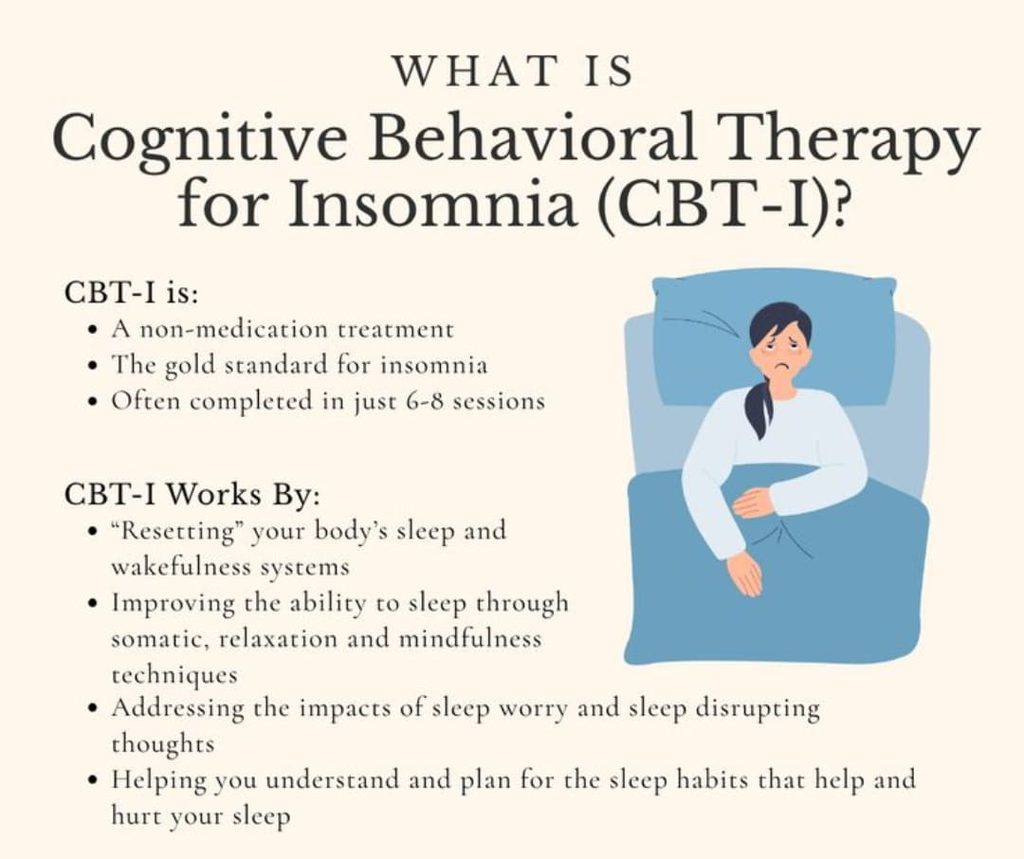
Cognitive Behavioural Therapy for Insomnia (CBT-I) is recommended as first-line treatment for chronic insomnia by NICE, the NHS, the American Academy of Sleep Medicine, and the American College of Physicians — all ahead of sleeping medication. The evidence is unambiguous. Starting with CBT-I for chronic insomnia leads to better outcomes than pharmacotherapy. Sixty to seventy percent of patients experience a clinical response to CBT-I — defined as meaningful improvement in insomnia symptoms — and approximately 50% achieve full remission after six to eight sessions. These outcomes are more durable than medication at 6-month and 12-month follow-up.
Yet only 6.2% of adults with insomnia report using CBT-I in the past year. Only 7.5% have ever used it. And 15% of the general population have ever heard of it. This is the most significant gap between clinical evidence and public knowledge in contemporary sleep medicine.
The Five Core CBT-I Components
CBT-I is not a single technique. It is a structured combination of five evidence-based components — each targeting a specific maintaining mechanism of chronic insomnia.
Stimulus Control rebuilds the conditioned association between bed and sleep by restricting bed use to sleep and sex only — removing all wakeful activities from bed and leaving the bedroom if unable to sleep after 20 minutes. It directly addresses conditioned arousal — the mechanism that makes the bed a cue for wakefulness in chronic insomnia.
Sleep Restriction Therapy deliberately limits the time allowed in bed to match the actual sleep time being achieved — typically six hours initially — building adenosine-driven sleep pressure and consolidating fragmented sleep into a shorter, deeper, more efficient sleep period. It is the most counterintuitive component — restricting sleep to improve sleep — and the most consistently effective single component of the CBT-I package.
Sleep Hygiene addresses the environmental and behavioural factors that interfere with sleep — including caffeine timing, alcohol, irregular sleep schedule, exercise timing, bedroom environment, and light exposure. Contrary to popular assumption, sleep hygiene alone is insufficient for chronic insomnia — it is necessary but not sufficient, and works most powerfully as a component of the full CBT-I approach.
Cognitive Restructuring identifies and challenges the unhelpful sleep-related beliefs that maintain insomnia anxiety — including catastrophic predictions about the consequences of poor sleep, unrealistic expectations about sleep needs, and the counterproductive clock-watching behaviour that amplifies sleep-onset anxiety.
Relaxation Training reduces the physiological arousal that prevents sleep onset through progressive muscle relaxation, diaphragmatic breathing, and the extended-exhale breathwork that activates the parasympathetic nervous system directly.
Paradoxical Intention — The Counterintuitive Technique
One of the most distinctive and most consistently underreported CBT-I techniques is paradoxical intention — the deliberate attempt to stay awake rather than to fall asleep. By removing the performance pressure of trying to fall asleep — which itself generates the anxiety that prevents sleep onset — paradoxical intention reduces the performance monitoring that hyperarousal drives, allowing sleep to occur naturally when adenosine pressure is sufficient.
For people whose insomnia is significantly driven by performance anxiety about sleep, paradoxical intention can produce rapid improvement in sleep onset latency — because it removes the very effort that was preventing the effortless process sleep requires.
Scheduled Worry Time — Externalising the Racing Mind
One of the most practically accessible CBT-I techniques for cognitive hyperarousal at bedtime is scheduled worry time — designating 20 minutes in the early evening specifically for writing down every concern, every unresolved problem, and the next available action for each. By externalising cognitive content before the sleep window, this technique prevents the nocturnal intrusion of unprocessed daytime concerns that is one of the most common insomnia-maintaining mechanisms.
Our anxiety journaling prompts guide provides structured prompts specifically useful for the pre-sleep worry externalisation that scheduled worry time involves.
Digital CBT-I — Free Access to the Gold Standard
NHS Sleepio — the digital CBT-I programme available free to NHS England patients — and equivalent programmes in USA, Canada, and Australia provide evidence-based insomnia treatment through a digital platform without waiting lists. Research confirms digital CBT-I produces outcomes comparable to face-to-face therapy — dramatically expanding access to the treatment that most adults with chronic insomnia have never received.
Medication — What the Evidence Actually Says
Sleep medications — including benzodiazepines, Z-drugs such as zopiclone and zolpidem, and melatonin receptor agonists — produce short-term improvements in sleep onset and maintenance. They do not address the maintaining mechanisms of chronic insomnia and are not recommended for long-term use by NICE or the AASM. In a clinical trial comparing CBT-I with medication, 85% of patients receiving CBT-I combined with gradual dose reduction were no longer using benzodiazepines immediately after treatment — confirming CBT-I’s value in supporting medication reduction alongside treating insomnia directly.
Short-term medication use — for acute insomnia during a crisis period — is clinically appropriate and supported by guidelines. Long-term reliance without CBT-I is not — both because of the dependency risks that accompany most sleep medications and because medication does not address the perpetuating factors that maintain chronic insomnia independently of the original trigger.
The 2026 Supplement Landscape
The 2026 surge in sleep supplement searching — with magnesium searches up 23% year-on-year to 135,000 monthly searches — reflects genuine public interest in non-pharmaceutical sleep support. The evidence differs significantly across supplements.
Magnesium glycinate and magnesium threonate have the strongest supplement evidence for sleep — with research supporting improvements in sleep onset time and subjective sleep quality in magnesium-deficient adults. Glycine — whose searches rose 175% year-on-year in 2026 — has emerging evidence for reducing core body temperature at sleep onset, supporting the thermal regulation mechanism that sleep onset requires.
These supplements function as adjuncts to, not replacements for, CBT-I for chronic insomnia. Always discuss supplements with your GP or pharmacist before beginning, particularly when taking other medications.
Accessing Help for Insomnia in Adults
United Kingdom:
- NHS — Sleep and Tiredness — self-help guidance and GP referral information
- NHS Sleepio — free digital CBT-I available to NHS England patients
- NHS Talking Therapies — free self-referral including CBT for insomnia with anxiety and depression
- NICE Insomnia Guidelines — clinical guidance
United States:
- AASM — Sleep Education — insomnia resources and treatment finder
- ADAA — Sleep Disorders — insomnia and anxiety connection
- VA Digital CBT-I Coach App — free CBT-I support tool
Canada:
- CAMH — Sleep Problems — mental health and sleep resources
- Canadian Sleep Society — find a sleep specialist
Australia:
- Sleep Health Foundation — insomnia resources
- Beyond Blue — Sleep — sleep and mental health support
- Healthdirect — Insomnia — insomnia guidance
Insomnia in Adults Key Takeaways — Featured Snippet
The complete 2026 evidence-based summary:
- 30–35% of adults worldwide report insomnia symptoms — 10% have chronic insomnia disorder
- 40% of people with insomnia have a diagnosable comorbid mental health condition
- 83% of adults with depression experience at least one insomnia symptom — the relationship is bidirectional
- 91% of adults with PTSD have insomnia symptoms
- 54% of adults cite stress and anxiety as their primary sleep disruptors
- Chronic insomnia is fundamentally a hyperarousal disorder — not simply difficulty falling asleep
- The conditioned arousal mechanism makes the bed itself a cue for wakefulness in chronic insomnia
- The Spielman 3P model — predisposing, precipitating, perpetuating — is the gold standard framework for understanding why insomnia develops and why it persists
- The glymphatic system — the brain’s overnight waste clearance mechanism — is chronically underactive in insomnia, with measurable long-term neurological consequences
- CBT-I is the NICE, NHS, and AASM first-line recommendation — producing 60–70% clinical response rates and superior long-term outcomes to medication
- Only 15% of adults are familiar with CBT-I — the most significant gap between evidence and practice in contemporary sleep medicine
- Stimulus control and sleep restriction are the most powerful individual CBT-I components
- Paradoxical intention — trying to stay awake — is one of the most effective techniques for performance-anxiety-driven sleep-onset insomnia
- NHS Sleepio provides free digital CBT-I for NHS England patients — comparable to face-to-face therapy in outcome data
- Magnesium (up 23% in searches) and glycine (up 175%) are the 2026 supplement trends with emerging sleep evidence
A Word From mindnesto
At mindnesto, we find it genuinely remarkable that the most prevalent sleep disorder in the world — affecting one in three adults — is being treated primarily with medication by a medical system that has its own guidelines recommending something more effective, more durable, and free of side effects.
The problem is not a lack of treatment. It is a lack of awareness — of the people who have insomnia, of the GPs who see them, and of a broader culture that still reaches for the pill rather than the therapy when sleep fails.
CBT-I works. It is free or low-cost. It is available digitally without a waiting list. And now you know it exists.
That knowledge alone is one of the most useful things mindnesto can give you. Use it. 💙
→ Read next: Sleep Problems in Adults — The Complete Guide
→ Also read: Depression and Sleep — How Each Makes the Other Worse
→ Also read: Sleep Hygiene and Mental Health
Frequently Asked Questions
What causes insomnia in adults?
Insomnia in adults develops through the Spielman 3P framework — predisposing factors including high trait anxiety and a naturally hyper aroused nervous system, precipitating triggers including stress, bereavement, or illness, and perpetuating factors including excessive time in bed, irregular sleep schedules, daytime napping, and the conditioned arousal that makes the bed a cue for wakefulness.
How does insomnia affect mental health?
Insomnia and mental health are bidirectionally linked. Insomnia reduces amygdala regulation — increasing emotional reactivity — and disrupts the REM sleep that processes emotional experiences and regulates mood. Adults with insomnia are significantly more likely to develop depression and anxiety.
Why do I wake up at 3am and cannot get back to sleep?
Early morning awakening — waking in the early hours and being unable to return to sleep — is one of the three classical insomnia presentations. It is particularly associated with depression and anxiety, where elevated cortisol disrupts the sleep architecture of the second half of the night, and with the conditioned arousal that makes wakefulness self-sustaining once it begins. CBT-I specifically addresses early morning awakening through sleep restriction, stimulus control, and cognitive restructuring of the catastrophic thinking that sustains wakefulness once begun.
Are sleeping pills safe for insomnia?
Sleeping medications including benzodiazepines and Z-drugs produce short-term sleep improvements but carry risks of dependency, tolerance, and cognitive side effects with long-term use — and are not recommended by NICE for use beyond four weeks. They do not address the perpetuating mechanisms of chronic insomnia. CBT-I produces superior long-term outcomes and supports medication reduction for people already taking sleep medication.
Sources and External References
- Sleep Foundation — Sleep Statistics 2026
- Global Health Beacon — Insomnia Sleep Statistics 2026
- ScienceDirect — CBT-I Outcomes Combined Medication Reduction 2025
- Tandfonline — Public Knowledge CBT-I Survey 2025
- PMC — CBT-I Neurodevelopmental Conditions Systematic Review
- PMC — CBT-I vs Pharmacotherapy Long-Term Remission Network Meta-Analysis
- PMC — CBT-I Alzheimer’s Parkinson’s Scoping Review
- Rising Trends — Top Sleep Trends September 2026
- NHS — Sleep and Tiredness
- NHS Sleepio — Digital CBT-I
- NICE — Insomnia Guidelines CG192
- AASM — Sleep Education Insomnia
- ADAA — Sleep Disorders and Anxiety
- Sleep Health Foundation Australia
- CAMH Canada — Sleep Resources
- Beyond Blue Australia — Sleep